
 newsbtc.com

In a comprehensive analysis shared via X (formerly Twitter), Alex Thorn, the Head of Firmwide Research at Galaxy, delved into the intricacies of the current Bitcoin market cycle, answering the question “Where Are We In This Bitcoin Cycle?” As Bitcoin trades robustly around $62,000, with a notable spike to $64.000 yesterday, the crypto landscape is witnessing unprecedented dynamics, marked by a surge in ETF inflows, strategic acquisitions by corporate entities, and a palpable shift in investor sentiment towards digital assets.
Thorn emphasized how different this cycle is:
Effectively, the bull runs of 2017 and 2020 hadn’t yet begun at this stage in Bitcoin’s supply schedule.
52 days before 2nd Halving (9-JUL-16) BTCUSD $455.22 (-59.86% from $ATH)
52 days before 3rd Halving (11-MAY-20) BTCUSD $6,174 (-68.56% from $ATH)
52 days before 4th Halving (20-APR-24) BTCUSD $59,330 (-12.16% from $ATH)
Why This Bitcoin Cycle Is Different
Central to his analysis is the record-breaking influx of capital into spot Bitcoin ETFs, with Thorn highlighting, “The $BTC ETFs took in a whopping net $576m of $BTC yesterday (Tuesday Feb. 27), with BlackRock alone seeing $520m of inflows, its largest ever day.” This significant movement of funds not only underscores the growing institutional interest in Bitcoin but also marks a pivotal moment in the cryptocurrency’s journey towards mainstream financial recognition.
A key aspect of Thorn’s analysis is the unwavering strength of Bitcoin’s long-term holder base, which he estimates to hold about 75% of the total $BTC supply. “Long-term holders are still mostly holding strong,” Thorn notes, emphasizing the community’s resilience and faith in Bitcoin’s long-term value proposition. This demographic, characterized by their ‘diamond hands’, plays a crucial role in stabilizing the market and buffering against the volatility that often defines the crypto space.
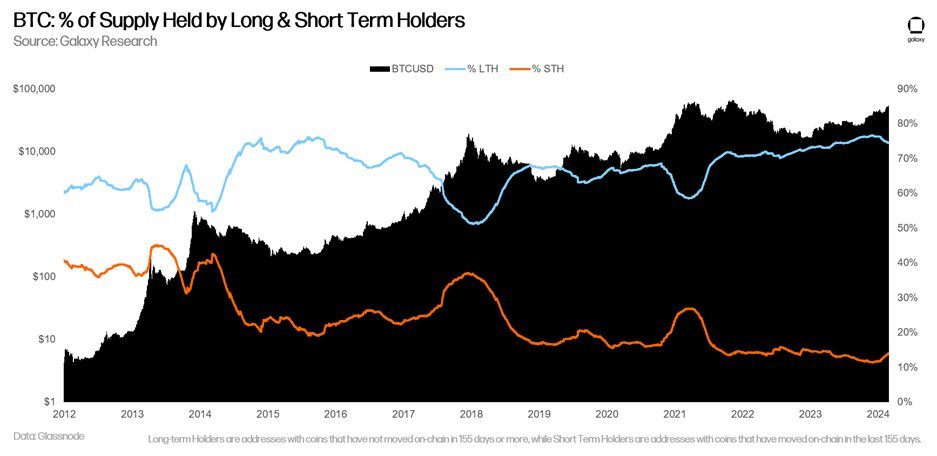
Thorn further elaborates on the analytical tools and metrics that provide insight into Bitcoin’s market behavior. He introduces the MVRV Z-Score, a novel approach to understanding the cyclicality of Bitcoin’s price action by comparing its market value to its realized value. This metric offers a window into the perceived overvaluation or undervaluation of Bitcoin at any given point. Currently, the MVRV Z-Score is close to 2, while previous cycle tops saw the metric spike to 8 (in 2021) or even above 12 (in prior halving cycles).
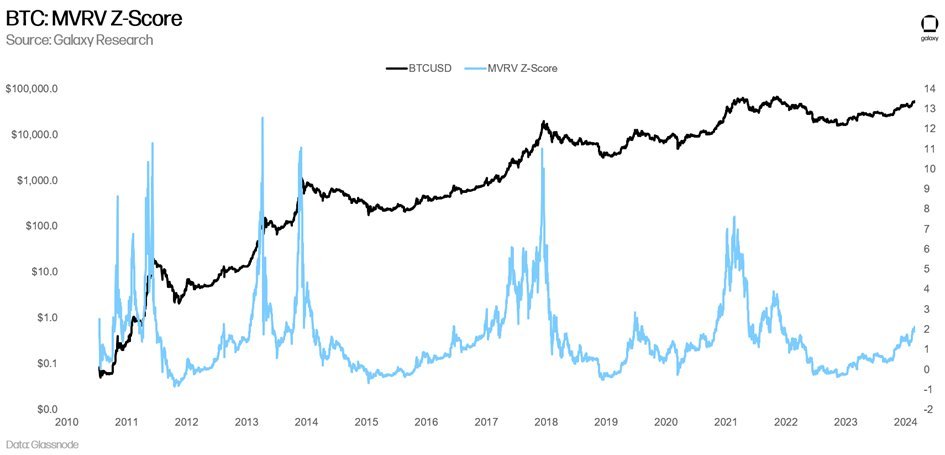
Addressing the speculation around the acceleration of the Bitcoin cycle, Thorn firmly dispels concerns that the market is prematurely peaking. He argues against the notion that we are “speedrunning the ‘cycle'”, instead asserting that the advent of Bitcoin ETFs in the United States represents a transformative shift with far-reaching implications. “This time is different,” Thorn asserts, pointing to the ETFs’ disruption of traditional Bitcoin price cycles and their impact on investor behavior and intra-crypto dynamics.



