That story is supported by the more comprehensive exchange flow data. At about -145 billion $SHIB, the total exchange netflow is still extremely negative, indicating that more tokens are leaving exchanges than are entering them. Additionally, daily exchange outflows are greater than inflows, indicating that holders continue to prefer self-custody over getting assets ready for sale.
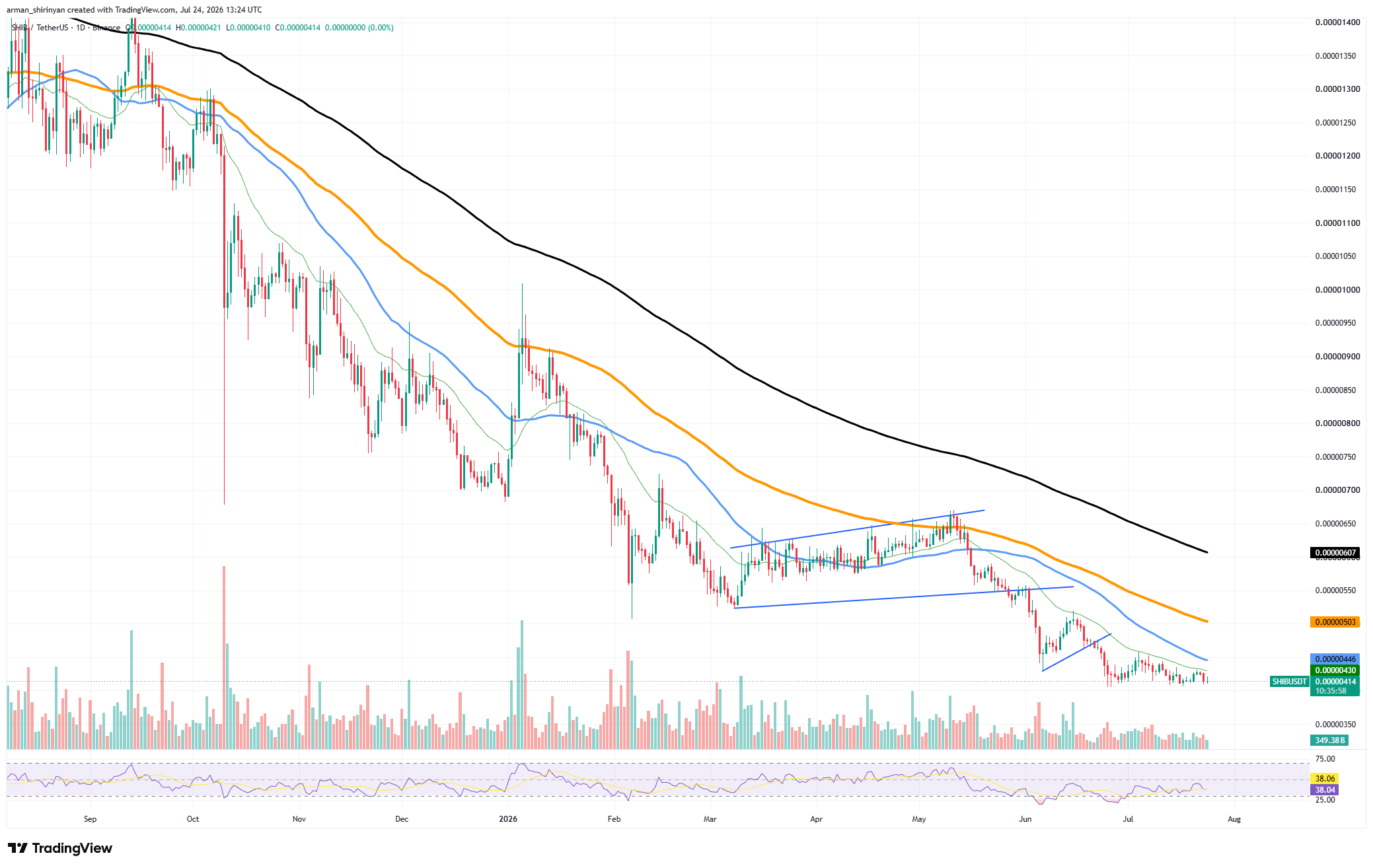
In essence, declining exchange balances tend to sustain bullish conditions over time since fewer coins are available if demand starts to pick up speed. Unfortunately for bulls, this improving supply dynamic has not yet been reflected in price. $SHIB is still stuck in a long-standing downtrend that has lasted for months, trading close to $0.0000041. All major moving averages are still pointing downward.
Shiba Inu's momentum
The token trades below the 26-day, 50-day, and 100-day exponential moving averages, while the 200-day moving average is still much higher, demonstrating the continued dominance of bearish momentum. A number of attempts at recovery have also been rendered invalid by recent price action. Before $SHIB could reach a higher high, earlier consolidation patterns eventually broke to the downside, with sellers consistently defending each rally.
The most recent candles are still printing lower lows, indicating that the overall trend is still in place. Momentum indicators provide little encouragement. The RSI is currently at 38, comfortably below the neutral 50 level despite a minor rebound from oversold territory. This implies that although selling pressure has somewhat subsided, buyers have not created enough momentum to buck the current downward trend.
Technical performance and on-chain fundamentals diverge in an intriguing way as a result. Tokens are being removed from exchanges by on-chain investors, which is gradually lowering the liquid supply and bringing reserves closer to the psychologically significant 100 trillion $SHIB milestone.

 u.today