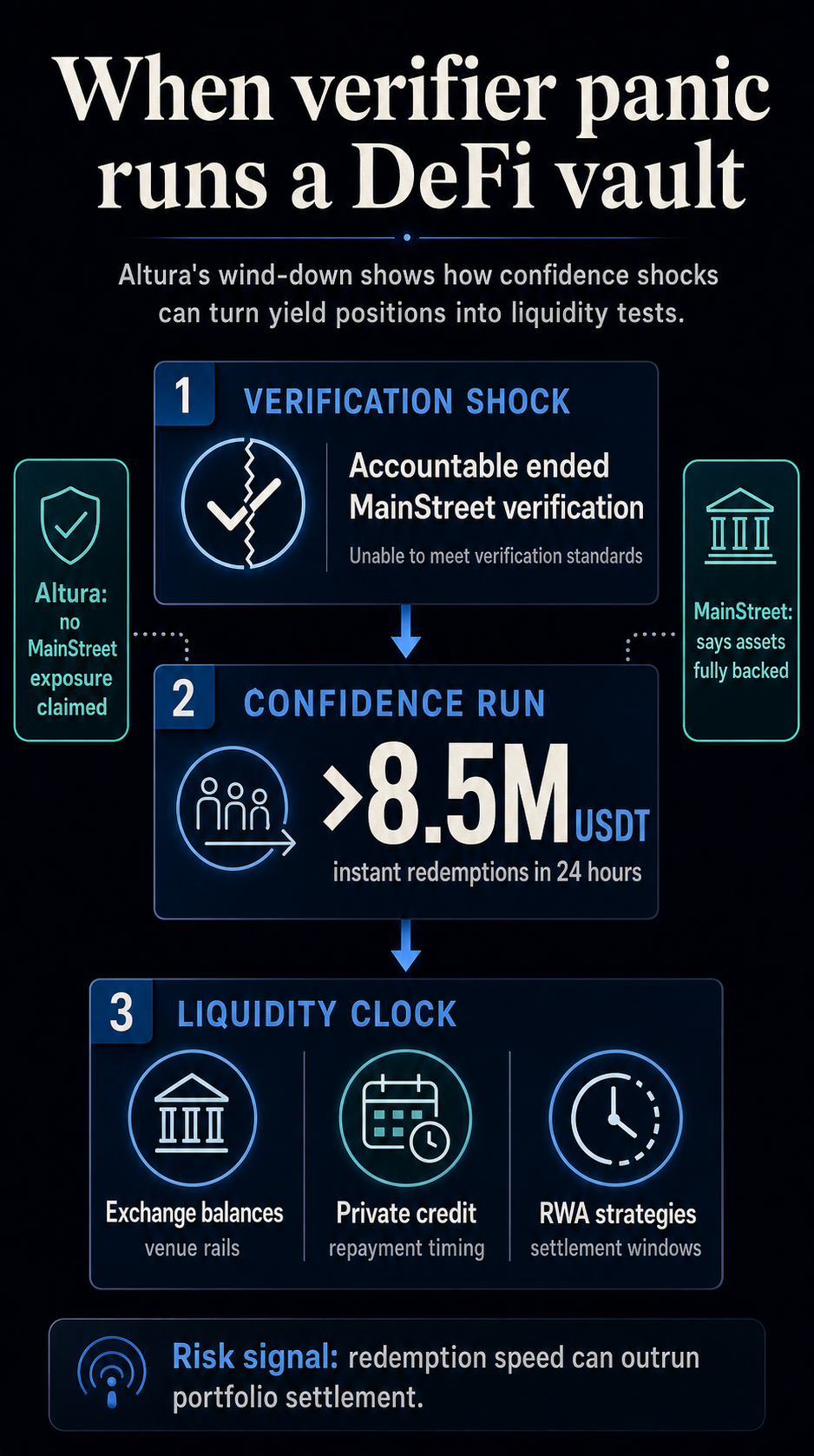
That is the operating risk Altura exposed. Redemptions can look simple from the user side, while exchange withdrawals, private credit repayments, and RWA settlement windows can all run on different clocks.
MainStreet then said the shutdown of a third-party proof-of-reserves dashboard did not reflect asset loss or portfolio deterioration.
Altura's own caveat is just as important. The protocol said it had no exposure to MainStreet or its underlying strategies and described its HyperEVM lending vault, the related $USDT/AVLT market, and Ethereum-vault borrowers as unaffected by the MainStreet event.
Once users saw a verification provider walk away from one yield-bearing stablecoin product, the question moved from whether a neighboring protocol had exposure to whether any similar product could handle everyone asking for cash at once.
Liquidity moves front and central when users all want cash
Stablecoin users often focus on the token. In this case, that was $USDT, one of crypto's main settlement rails. $USDT easily held its peg at $1, with roughly $186 billion in market value and more than $51 billion in 24-hour trading volume.
That context cuts in two directions. $USDT is deep market infrastructure, so a $USDT-denominated vault needs to be enormous to have any effect on overall liquidity. At the same time, a vault's liquidity depends on how the vault uses deposits, where the assets sit, which settlement rules apply, and whether counterparties can return cash on the same timeline users expect.
Altura's wind-down statement pointed to that operating reality. Exchange allocations may be easier to turn into liquid balances than private credit or RWA strategies, but even exchange balances can depend on venue procedures, withdrawal rails, and market conditions. Private credit and RWA positions introduce another clock because repayments, redemptions, or settlement windows may not match the speed of a DeFi withdrawal queue.
That mismatch is why confidence is critical even without a confirmed loss. If the first group of users can redeem instantly and later users must wait for positions to mature or settle, everyone has an incentive to become early. The mere possibility of staged liquidity can accelerate redemptions.
However, the scale is still meaningful. The Altura tracker placed the protocol in the tens of millions of dollars, making an 8.5 million $USDT redemption wave material relative to the vault's footprint. So, a large same-day withdrawal can force a portfolio built for yield into becoming one built for liquidity.
The next signal is the redemption clock
The broader stablecoin market makes the lesson harder to dismiss. The stablecoin sector has hundreds of billions of dollars in market value and tens of billions of dollars in daily trading volume. Yield-bearing versions promise stable units plus returns generated by strategies that may not be instantly reversible.
Those products can function, but their risk is partly operational in nature. Reserve claims, verification dashboards, exchange allocations, private credit positions, and RWA strategies all become most important when users decide they no longer want yield and only want cash.
For Altura, the next signal is the wind-down: whether positions are redeemed on an orderly timeline, how often Altura updates users, how much liquidity comes back at each stage, and whether the process avoids rushed exits from slower assets. The sourced record supports that liquidity question; it does not support treating the MainStreet dispute as proof about Altura's assets.
For the rest of the yield-bearing stablecoin market, the test is whether verification can survive stress as a confidence tool rather than become a single point of panic. Proof-of-reserves dashboards and third-party attestations are meant to reduce uncertainty, but a terminated relationship can also become a headline that users interpret faster than issuers can explain.
That is the lesson from Altura's redemption rush. In DeFi vaults, confidence is not a soft metric. It decides whether users leave their money in a strategy long enough for the strategy's timeline to work.

 cryptoslate.com