
 thestreet.com
We saw several AI-powered crypto trading platforms promise to put sophisticated investment technology in the hands of everyday investors. A new study suggests most people who used them lost money.
Researchers from Pantera Capital, Stanford University, and IC3, alongside Ava Labs, the blockchain technology company behind the Avalanche network, analyzed 11 AI trading agent platforms on Solana, covering 925,323 wallets.
Solana is a blockchain network designed to support decentralized applications and financial services.
It is best-known for processing transactions quickly and economically, which has made it a popular destination for developers building crypto applications.
Their findings, published in a paper titled "Paper Agents, Paper Gains: An Empirical Analysis of DeFi Investment Agents," are stark.
It reveals that users collectively lost $191.7 million, despite those same platforms sitting on $34.3 million in paper gains inside their own treasuries.
Trending on TheStreet Roundtable:
- Analyst predicts $1M price target for XRP
- Mysterious trader pockets millions in profits ahead of CPI data
- 'Big Short' investor sends warning on SpaceX's June 12 IPO
Big promises, bigger losses
The platforms surveyed, including ai16z/Eliza, Truth Terminal, and Zerebro, attracted billions in combined token valuations between late 2024 and early 2025.
At their peak, aggregate user gains across all platforms reached $2.4 billion. By February 2026, that had collapsed into a collective net loss.
Token prices told an even grimmer story.
Across all platforms, tokens declined 93% on average from their all-time highs, nearly twice the severity of Solana's own 54% peak-to-trough drawdown during the same period.
The gains that did exist were captured by a very small group. The top 1% of profitable wallets, just 2,590 out of 259,016 wallets that made any money, took home 81.4% of all gains, totalling $1.81 billion.
The single largest individual profit was $158.2 million, on the ai16z/Eliza platform.
Meanwhile, 62.2% of all participants, representing 575,246 wallets, realized losses. Median returns were negative on nearly every single platform studied.
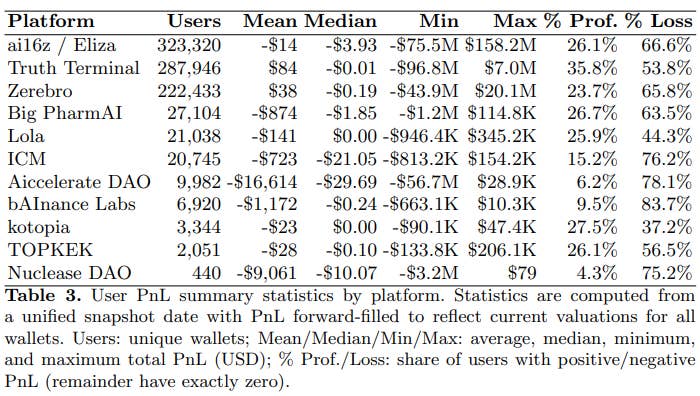
Source: Paper Agents, Paper Gains: An Empirical Analysis of DeFi Investment Agents
Most AI agents weren't actually trading
The study also found that most of these platforms were not doing what they claimed. Of the 10 projects surveyed in the broader landscape analysis, only three were actually executing trades autonomously.
The rest were providing investment advice, running simulations, or requiring users to approve every trade manually. Developer interviews confirmed the gap.
The ElizaOS team told researchers that "LLMs cannot trade well" without human insight, while Virtuals Protocol said genuine autonomous execution remains rare even across its 17,000-plus agent launches.
The researchers stopped short of calling the platforms fraudulent, noting instead that the market remains early and immature — and that the infrastructure needed for AI agents to trade effectively simply does not exist yet.