
 ambcrypto.com
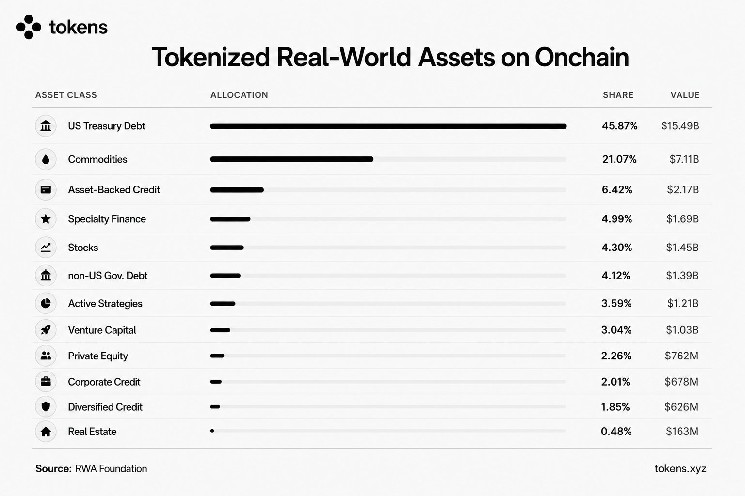
While broader crypto markets continued facing volatility pressure, tokenized RWAs steadily expanded across institutional blockchain infrastructure. Earlier growth near the $30 billion region had already reflected accelerating adoption among traditional financial participants.
That momentum strengthened further once on-chain RWAs reached a new all-time high near $33.78 billion during May 2026.
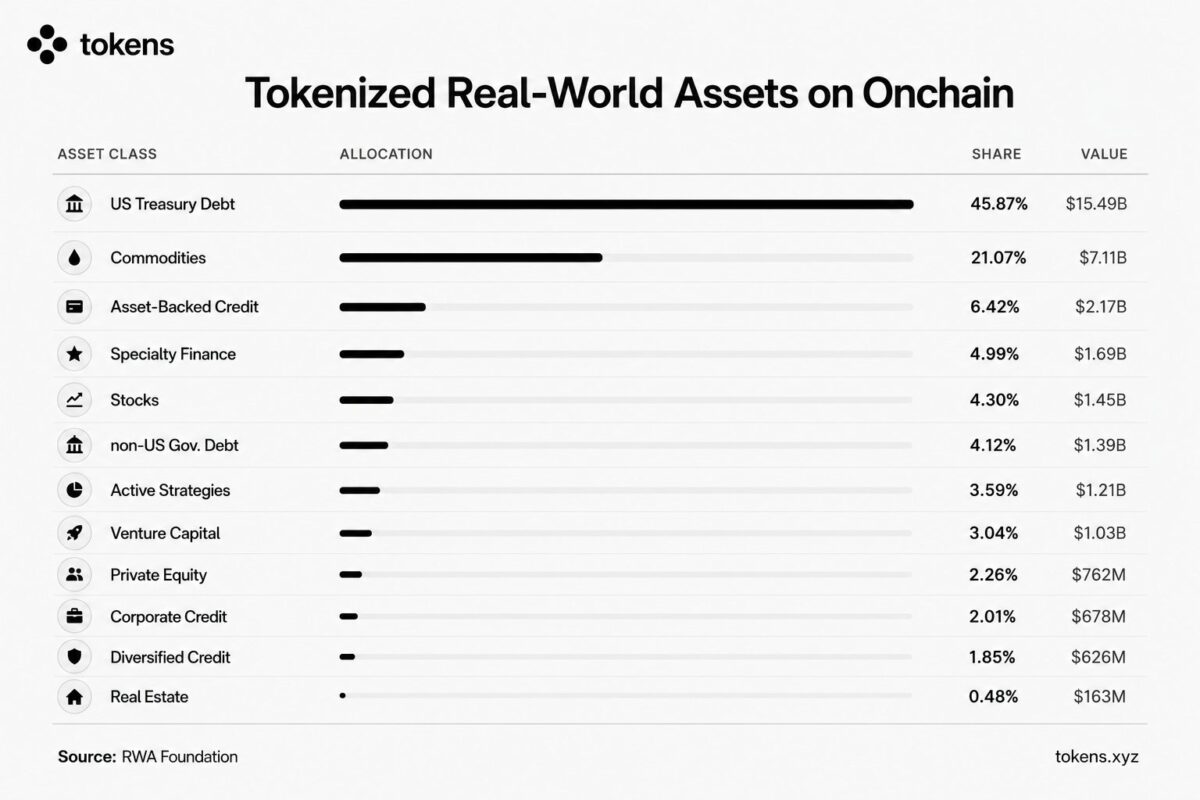
Meanwhile, U.S. Treasury debt dominated the sector with roughly $15.49 billion, representing nearly 45.87% of total allocation. Commodities followed with approximately $7.11 billion, while asset-backed credit surpassed the broader $2.17 billion region.
That structure increasingly suggested institutions preferred yield-generating and lower-risk assets while gradually integrating blockchain settlement infrastructure. However, concentration around Treasury products still highlighted cautious institutional expansion rather than aggressive diversification across broader tokenized markets.
Institutional demand accelerates tokenization adoption
As tokenized real-world assets [RWAs] continued expanding across blockchain networks, institutional demand also shifted steadily toward programmable financial infrastructure and settlement efficiency.
Earlier growth from nearly $21 billion had already reflected accelerating enterprise adoption across broader capital market systems.
That momentum strengthened further once on-chain RWAs climbed toward roughly $33.71 billion during mid-May 2026.
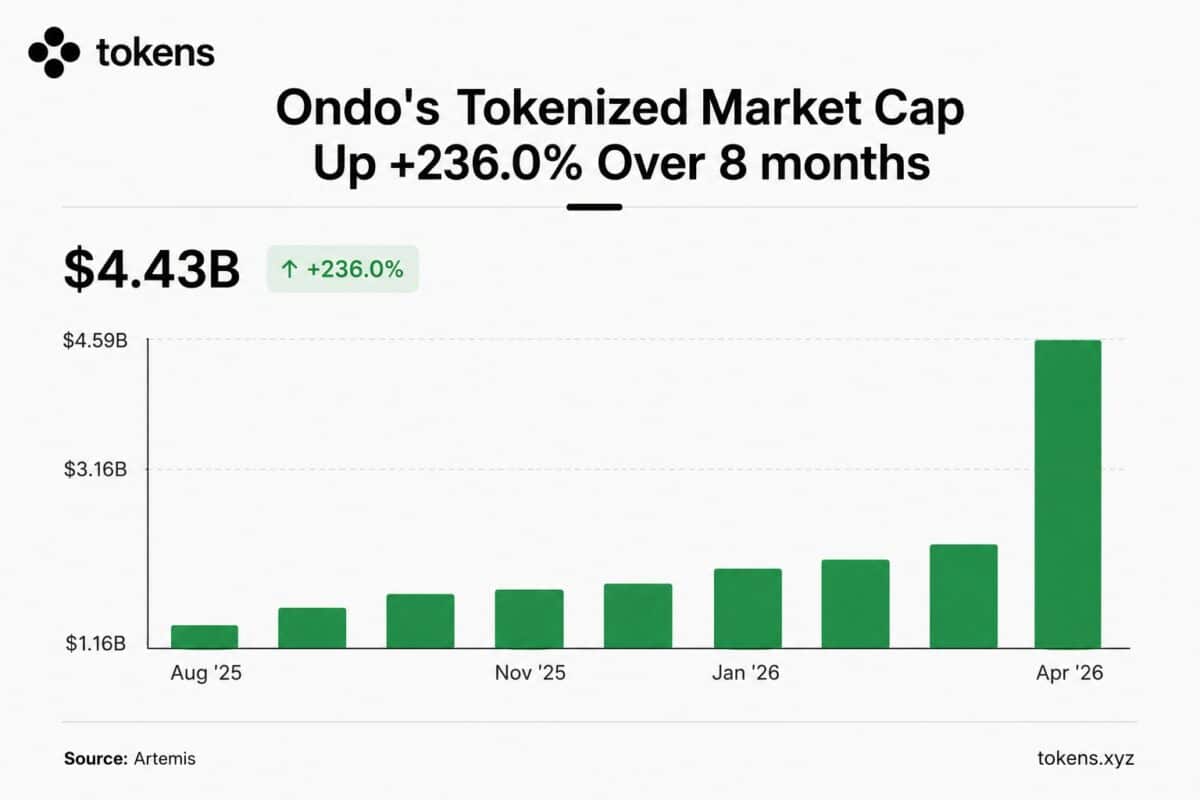
In fact, Ondo Finance [ONDO] expanded its tokenized market capitalization by more than $2 billion within a single month, pushing total growth above 236% across eight months.
Tokenized U.S. Treasuries also approached nearly $13 billion as BlackRock’s BUIDL and Franklin Templeton’s BENJI expanded adoption across institutional settlement rails.
That structure increasingly showed institutions prioritized faster settlement, lower counterparty risk, and continuous market accessibility. However, broader adoption still depends on stronger interoperability, deeper liquidity, and clearer compliance standards.
Blockchain infrastructure powers tokenization growth
As institutional tokenization adoption accelerated, blockchain infrastructure providers increasingly became the backbone supporting broader financial settlement activity.
Earlier RWA growth beyond the $31 billion region had already strengthened reliance on compliant oracle and interoperability systems.
That dependency intensified once tokenized U.S. Treasuries surpassed roughly $15 billion during mid-May 2026. Infrastructure providers like Chainlink [LINK] also expanded their role across pricing feeds, NAV calculations, and cross-chain coordination for tokenized financial products.
That structure showed institutions prioritized operational efficiency because traditional settlement systems still faced slower execution and fragmented liquidity.
However, long-term adoption still depends on whether tokenized finance continues expanding steadily during weaker crypto market conditions.
Final Summary
- Tokenized RWAs reaching $33.78B increasingly reflect mainstream blockchain adoption across financial settlement and yield-generating markets.
-
Current growth increasingly reflects institutional demand for bringing traditional financial assets onto programmable on-chain infrastructure.