
 u.today

One of the most significant market stories at the moment is the conflict between Bitcoin and gold, as investors choose where to put their money in the face of increased global uncertainty and a changing willingness to take on risk. Bitcoin has long been marketed as digital gold, but recent market activity indicates that traditional gold has drawn much larger flows, putting pressure on the cryptocurrency markets.
Nothing without Bitcoin
Bitcoin saw a dramatic breakdown after failing to hold onto higher support levels, which caused the price to quickly move toward the mid-$60,000 region. Current attempts at stabilization have not been successful, and the asset is currently trading far below important moving averages. Market sentiment has been significantly impacted by selling pressure and liquidation cascades, making traders wary of the likelihood of an immediate recovery.
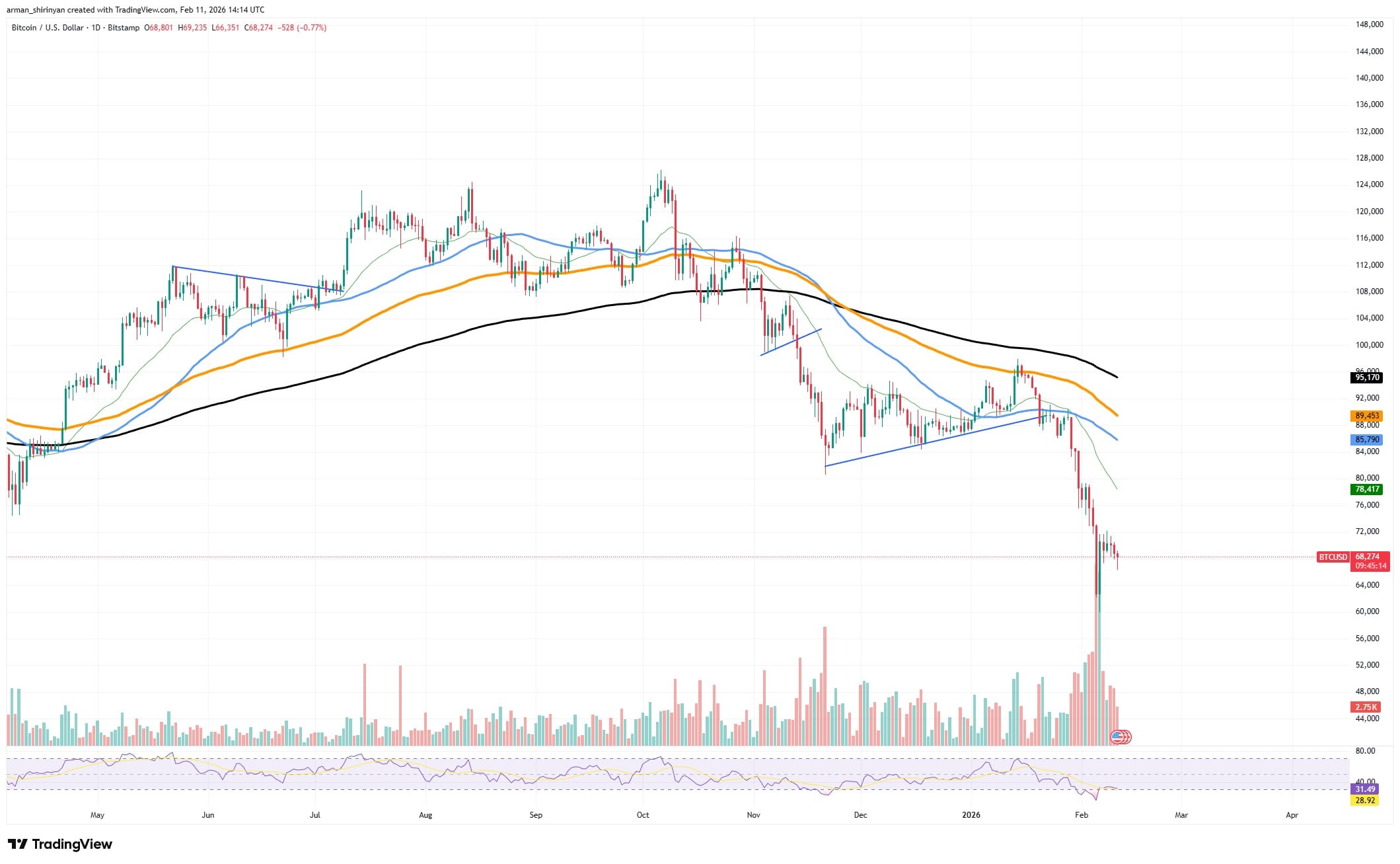
Gold is still showing strength, though. Due to its consistent upward trajectory, the precious metal has drawn investors looking for stability and defense against macroeconomic risks. The fact that gold prices are rising suggests that investors continue to prioritize traditional safe-haven assets over erratic substitutes like cryptocurrencies.
For markets, this dynamic results in a crucial crossroads. The rivalry between Bitcoin and gold is more than just symbolic; it shows where institutional and individual investors feel most comfortable allocating their funds. The cryptocurrency markets might stay in a defensive stance if gold keeps outperforming, with altcoins and speculative assets enduring persistent selling pressure.
But if Bitcoin starts to beat gold and once again emerges as the more visually appealing asset, the ramifications might be profound. The digital asset industry's risk appetite would probably be rekindled by a significant shift in capital flows back toward Bitcoin, which could lead to a recovery of the larger cryptocurrency market.
$XRP touches ceiling
Ironically, $XRP may have already reached what traders refer to as a price ceiling much earlier than many anticipated, despite the fact that it is still declining. $XRP's upside potential may be limited for the near future due to weakening network activity and declining trader participation, despite the fact that price action is currently characterized by a strong downtrend.
Technically, after failing to maintain its descending channel structure, $XRP has broken through several support levels in recent weeks, moving the asset toward the $1.30-$1.40 zone. Recovery attempts are still flimsy, as sellers swiftly regain control following each bounce, and moving averages continue to slope downward, confirming ongoing bearish momentum.
In a typical scenario, declining prices would eventually lead to new activity and appealing entrance points. On the other hand, on-chain signals indicate the opposite. The volume of transactions and payments on the $XRP Ledger has drastically decreased from previous highs, suggesting that traders and institutions' overall activity has slowed. Because fewer transfers and settlement flows traverse the ecosystem, decreased network usage frequently reflects waning speculative interest.
Because $XRP's valuation has historically benefited from strong transactional use and liquidity flows, this decline in ledger activity is especially significant. A decrease in network participation makes it more difficult for prices to gain sustained upward momentum, thereby capping attempts at recovery, even as prices continue to fall.
That is to say, $XRP might have already hit a functional price ceiling — not in the sense of reaching all-time highs, but rather in the sense that there is little room for growth as demand declines. Rally duration is at risk if traders do not participate more actively and with renewed vigor.
Dogecoin might recover
Although Dogecoin is currently trading close to levels that put the asset at a crucial technical crossroads, it is crucial to remember that nothing clearly bearish has happened thus far. Price action currently stands in an area where historical buying interest has previously emerged, making a bounce more than likely, even though months of gradual decline have pushed $DOGE back toward the $0.09 region.
The broader trend still points downward, with $DOGE trading below major moving averages and forming lower highs over recent months. The asset has been steadily declining due to selling pressure, and speculative interest in meme coins has subsided in comparison to previous market cycles. But as of yet, neither a structural collapse nor a period of panic-driven capitulation have been brought on by the most recent decline.
Rather, Dogecoin is currently trading in an area that has historically served as a base of support, and new candles indicate that sellers might be slowing down. Momentum indicators are getting close to oversold territory, which means that if buyers intervene at current levels, the downside pressure may soon subside.
Rekindled speculative interest may result from a successful recovery from this region, particularly if sentiment on the larger cryptocurrency market stabilizes. In this case, $DOGE might start to make up ground and possibly eliminate a decimal place once more by driving the price back above the psychologically significant $0.10 threshold, which would remove a zero from the quoted price.
$DOGE might have to deal with another selling wave before locating a stable floor if support does not hold. As a result, market participants continue to exercise caution and keep a close eye on whether buyers will defend current levels in the upcoming sessions.