
 coindesk.com
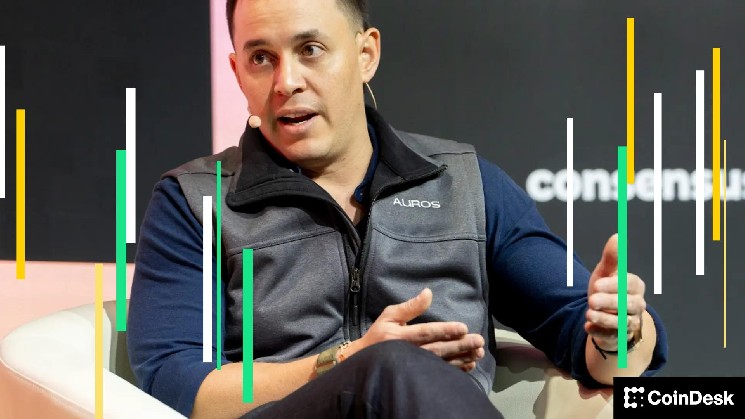
Crypto markets have spent the past year talking up institutional demand, but one constraint keeps resurfacing beneath the headlines: there's just not enough liquidity currently in the market to let Wall Street enter with its size and scale without destabilizing prices.
Speaking ahead of Consensus Hong Kong, Jason Atkins, chief commercial officer at crypto market maker Auros, said illiquidity, not volatility, remains the industry’s biggest structural problem.
"You can’t just say institutional capital wants to come in if you don’t have the avenue for them to do it,” Atkins said.
The issue, he argued, is whether markets can withstand the size of institutional appetite.
“It’s one thing to be like, ‘we’ve convinced them to come now,’” Atkins continued. “It’s like, well, do you have enough seats in the car?”
According to Atkins, crypto markets are illiquid not because interest has vanished, but because major deleveraging events like the October 10 crash have pushed traders and leverage out of the system faster than they can return.
Liquidity providers respond to demand rather than create it, meaning thinner trading activity naturally leads market makers to pull back risk. That reduction in depth then feeds into higher volatility, which in turn triggers stricter risk controls and further withdrawal of liquidity.
Institutions, he argued, are structurally unable to step in as stabilizers while markets remain thin, leaving no natural backstop when stress hits. The result is a self-reinforcing cycle in which illiquidity, volatility, and caution feed into one another, keeping markets fragile even as longer-term interest remains intact.
Volatility itself, Atkins said, is not what deters large allocators. The problem emerges when volatility collides with thin markets.
“Harnessing volatility is difficult in illiquid markets,” Atkins said, because positions become hard to hedge and even harder to exit.
That dynamic, he said, matters far more for institutions than for retail traders.
Large allocators operate under strict capital preservation mandates that leave little tolerance for liquidity risk.
“When you’re worth that much money, or if you’re a massive institutional player,” Atkins said, “it’s not about 'can you maximize yield.' It’s 'can you maximize yield relative to capital preservation.'”
Atkins also pushed back on the idea that capital is simply rotating out of crypto and into artificial intelligence, arguing the two are not at the same point in their cycle. While AI has existed for years, Atkins said its surge in investor attention is relatively recent, and is not causing capital inflows to crypto to dry up.
By contrast, crypto is further along in its cycle and now dealing with consolidation rather than novelty.
“I do think that the industry has started to reach a point of consolidation,” Atkins said, adding that “there’s not as much financial innovation happening.” Many of crypto’s core primitives, he noted, are no longer new. “Uniswap and AMMs, and the AMM model is not a new thing,” he said.
The slowdown in crypto liquidity is less about money being pulled away and more about the absence of new structures that attract sustained engagement. Crypto, Atkins said, is having its 'LLM moment'.
The liquidity problem, in his view, is structural rather than cyclical, or about a new risk asset siphoning capital from others. Until markets can absorb size, hedge risk, and exit cleanly, new capital will remain cautious.
Interest may still be there, Atkins said, but liquidity, not narrative, will decide when it can act.