Still, Stellar’s technicals leave some room for doubt since factors such as the relative strength index (RSI) fail to give a clear indication of whether $XLM’s next move will be downward or upward. Thus, Finbold elected to consult its artificial intelligence (AI) systems on how the token might fare through the rest of January.
AI sets $XLM price target for January 31, 2026
On average, the AI models included in Finbold’s prediction system proved rather conservative about $XLM’s performance by January 31, 2026. Overall, Stellar is expected to trade at $0.249 at the end of the month, just 2.9% above its press time price.
Claude Opus 4.1 was the most bullish as it predicted a 10.7% climb to $0.26. Gemini 2.5 Flash, on the other hand, was not only conservative but mildly bearish with a $0.239 price target – 1.15% below the press time price.
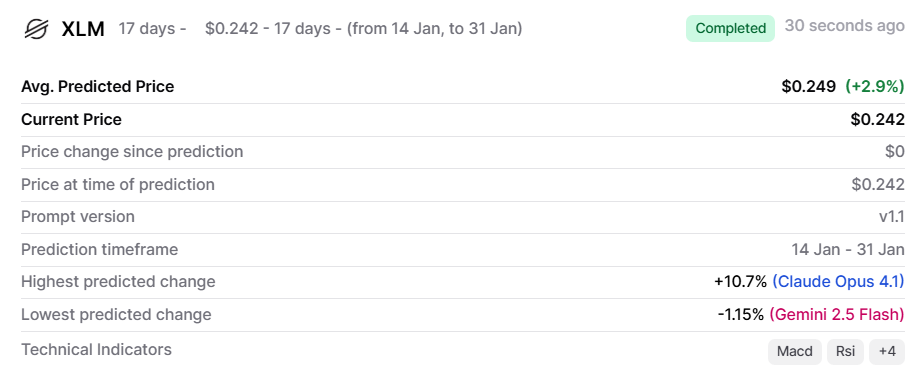
Technicals utilized by the AI system reveal much about why the prediction proved so measured. Indeed, factors like the RSI give no clear indication of direction, while the moving average convergence divergence (MACD) slope shows only that the downtrend is slowing but has not yet tipped into a bullish signal.
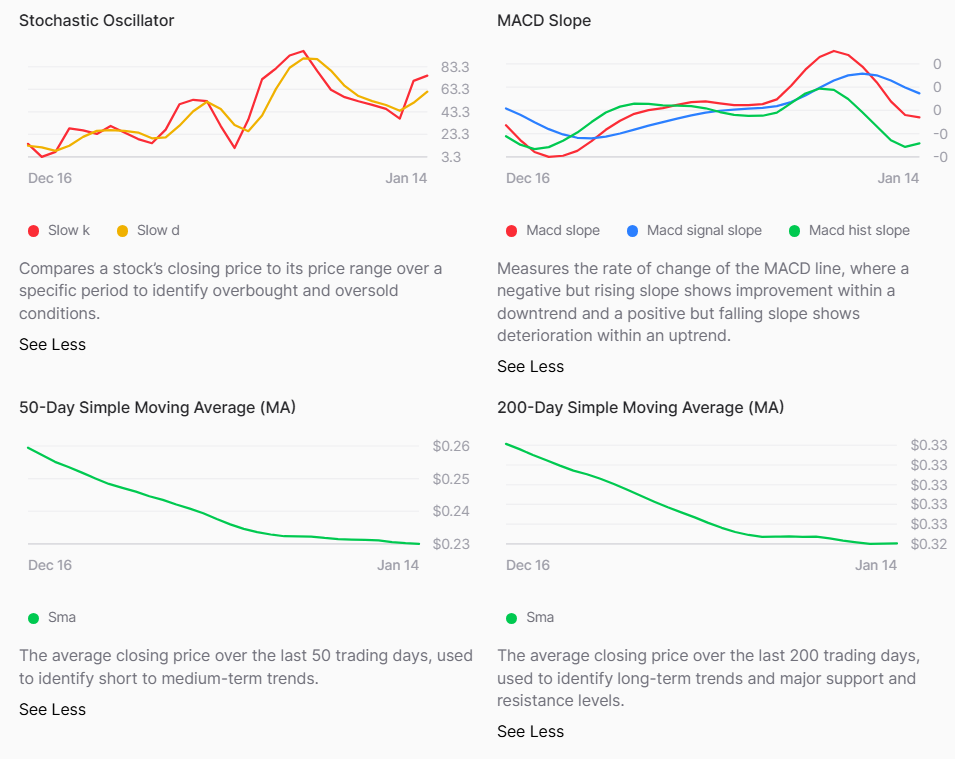
The simple moving average (SMA) charts for the last 200 and 50 days, however, might be the smoking gun, as they show first a rather pronounced downtrend and then a stabilization consistent with the AIs forecasting $XLM would end January within 10% of its January 14 price.
Featured image via Shutterstock

 finbold.com