
 cryptonews.net

By the end of 2025, crypto had more institutional connections and control over it, although prices were taking a hit. In late December, Bitcoin fell below $88,000, pulling down most of the other major altcoins and reducing overall crypto market value by approximately $58 billion. Nevertheless, the largest news of the year was regulation, spot ETFs, and government interest in Bitcoin reserves.
In 2025, various governments took the step to establish crypto-fit within the current financial and legal frameworks. In the meantime, electronic markets made access to any part of the world with new spot exchange-traded funds based on key tokens. In addition to changes in policy, dealmaking also increased rapidly, and there were reports of record crypto transaction activity, and an increased number of deals than in 2024.
The Crypto Push Store of Australia Shone in Law and Court
Australia had come up with two of the most-open policy stories of the year. In November, the Australian Treasury published a draft bill, according to which crypto exchanges would fall under the framework of the Australian Financial Services License. The proposal also considered some digital-asset platforms and tokenized custody services to be a financial service. Therefore, the regulations would require more crypto businesses to have an AFSL in case the regulations are implemented.
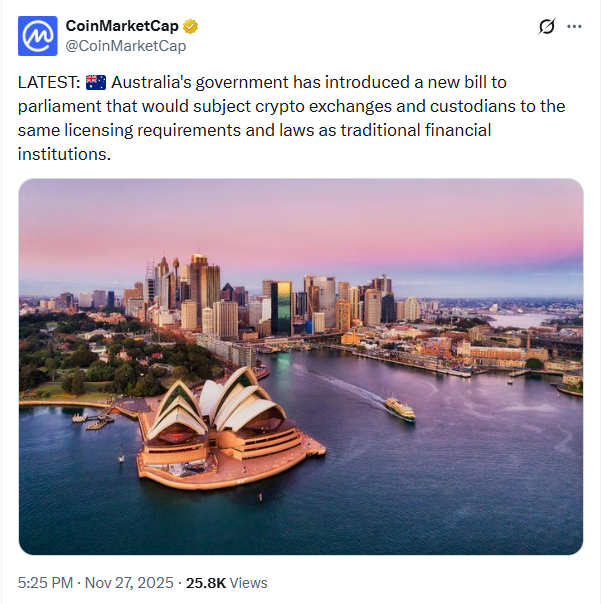
Source: X
The draft was based on a wider digital-asset strategy announced in March. The purpose of such a strategy was to establish more specific regulations on digital assets and payment stablecoins. So far, the exchange in Australia was required to be registered with the AUSTRAC and comply with anti-money laundering and customer identification requirements.
In the past, one of the court cases in Australia raised controversy regarding the way Bitcoin should be treated by law. In May, Judge Michael O’Connell suggested that Bitcoin transactions need to be treated like cash, and not investment assets to use in capital gains. The case concerned claims that a former federal police officer had stolen 81.6 BTC in 2019. The ruling proposed a limited scope, which would cover Bitcoin and transactions that take place after 2019 should it not be overruled on appeal.
In Australia, crypto also continued to be of great concern among regular people. The source text has cited research that found approximately 31% of Australians had invested or held crypto. It also indicated that the majority of crypto holders had Bitcoin, and many of the respondents considered Bitcoin as money or a store of value.
U.S. states weighed Bitcoin Reserves as the Idea Went Political
In the United States, state politics of Bitcoin reserves became popular at the beginning of 2025. This is due to the momentum following the Bitcoin reaching new all-time highs in 2024, which caught the attention of the lawmakers to its hedge narrative. According to the text of the source, measures were under consideration in Texas, Pennsylvania, Ohio, New Hampshire, and North Dakota by the end of 2024.
The interest of the state persisted until 2025. In December, Texas also declared a crypto reserve and a purchase of 5 million Bitcoins. The officials termed the purchase as a temporary arrangement as the state tried to contract with a crypto bank. The relocation consumed half of a 10-million fund and made Texas the first state to invest in such a store, according to the given reading.
According to the given content, Bitcoin and Ethereum were not the only Spot ETFs to expand in 2025. Dogecoin and $XRP were listed in the US in September in exchange-traded funds offered by REX-Osprey. The tickers used in the source were DOJE in the Dogecoin ETF and XRPR in the $XRP ETF of Cboe.
The listings were a significant move towards major altcoins in conventional market wrappers. Dogecoin was initially a parody token in the year 2013, but over time, it expanded to become a mainstream retail asset. $XRP maintained a separate story with regard to international payment and settlement effectiveness. Also, such listings indicated ongoing demand for regulated access vehicles bigger than the largest tokens.
Fund Flows Became Negative with the Increase of Macro Uncertainty.
All headlines of 2025 were not upward. According to the text, in November, crypto investment products registered a second consecutive week of $1.3 billion in weekly outflows. Cryptocurrency products were approximately $932million, and Ethereum products registered about $438million in redemptions. Meanwhile, short Bitcoin products attracted the biggest inflows since May.
The original text associated the pullback with investor warning in the face of a long government shutdown in the US and scant economic statistics. Such a combination lowered the risk appetite and burdened positioning in crypto funds.
Another general market decline was experienced at the end of the year as outflows continued. The given update indicated that Bitcoin dropped to less than $88,000 in December, and altcoins collapsed. Ether was around the 3,000 level following a 1.5% drop. The text has reported NFTs as the worst-performing, with decreases of over 9% on the leading collections.
In the same update, the total crypto market cap decreased to approximately $2.91 trillion following a decrease of $58 billion. Some lesser tokens had reported sharp losses of up to 24 hours, such as Midnight (NIGHT), the text reported dropping 28%. Large 2025 drawdowns in a number of major altcoins (Solana, Dogecoin, Cardano, Avalanche, and Shiba Inu) were also quoted by the same source.
Institutional involvement however, increased according to dealmaking data. The given source quoted a report in the Financial Times stating that there were $8.6 billion of crypto transactions by 2025. The number of deals listed in the same text by PitchBook was 267, which is an 18% rise over 2024. It further implied that conservative finance players were considering crypto to be lasting and investing in it with acquisitions.
The text also included other headlines in late December that were concerned with policy and market structure. One of the updates indicated that Russia offered a framework, according to which retail and qualified investors could purchase digital assets based on specified rules. It also had an annual limit on purchases by retail investors and a testing requirement to both groups. Another point of the proposal would be to classify digital currencies and stablecoins as currency values, but prohibit the use of domestic payments.
In the meantime, the US-based spot Bitcoin and Ethereum ETFs experienced net outflows before the holiday, according to the SoSoValue data used in the text. The update connected the shift to thin liquidity, rebalancing, and taking off profits as opposed to a significant conviction shift. In addition to the ETF flows, the same text also reported a 25-basis-point increase in Bank of Japan rates and associated it with the general risk-off environment. It also cited a different Japanese proposal of shifting the crypto tax to a flat 20%.
Lastly, the development featured the expansion of a Trump-linked stablecoin project. It claimed that the $USD1 stablecoin of World Liberty Financial grew its market value by approximately $150 million, to approximately $2.9 billion. It linked the jump with the $USD1 Boost Program of Binance, which provided better yields of $USD1 on Simple Earn Flexible products.