
 cryptonews.net

November 2025 turned into another turbulent month for the crypto market. After several brutal liquidations in October, traders expected some pullbacks and stability, but instead the market delivered wild volatility. Regulatory moves in the USA renewed volatility in altcoins, and several major token unlocking events only added fuel to the fire. While privacy coins saw decreased demand after their explosive rallies, regulated digital banking news pushed certain coins higher.
Overall, one tendency was clear: gainers gained mild percentages in crypto terms, while losers had substantial sell-offs.
Top 5 Gainers
Crypto coins saw a rise as payment methods for online casinos and other entertainment industries. Among those, WildRoll keeps expanding its features and reward mechanics to be competitive. You can browse the WildRoll Bonus Buy-In list to see which crypto tokens are supported.
November’s strongest performers came from crypto projects benefiting from renewed liquidity, positive regulatory impact, and rising real-world utility themes. These tokens not only recovered from October’s downturn but also showed solid momentum, supported by increasing trading volumes and fresh market demand, as well as strong fundamentals and regulatory easing.
Telcoin TEL (80%)
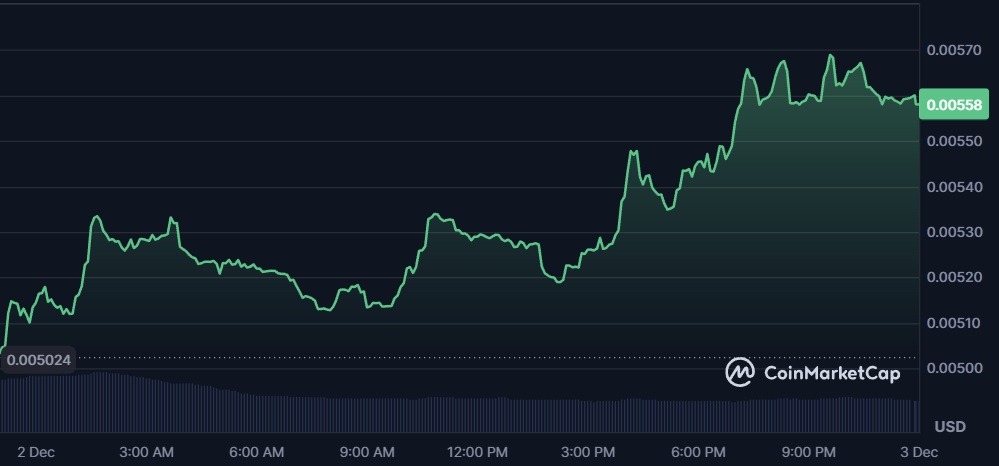
The Telcoin crypto project was launched in 2017, and its real-world utilities include mobile-based crypto remittances, allowing users to send and receive money globally through telecom networks. Telcoin also builds DeFi services, and with a new regulatory green light, it plans to offer digital banking products as well.
It was pumped after the news came out of the USA about its approval of a digital asset bank. Telcoin got a regulatory green light in Nebraska to operate a crypto asset bank, which boosted its price tremendously. Hence, the over 80% price surge in November.
News attracted new buyers, and liquidity increased, causing the price to break out from several levels, triggering even a big technical rally.
The project also has plans for a stablecoin, eUSD, which will make it even more attractive for remittances. This is huge news for the crypto world, which is approached very skeptically by regulators, especially when it comes to banking products, and this news is a solid foundation for the project's future success.
Quant $QNT (24%)
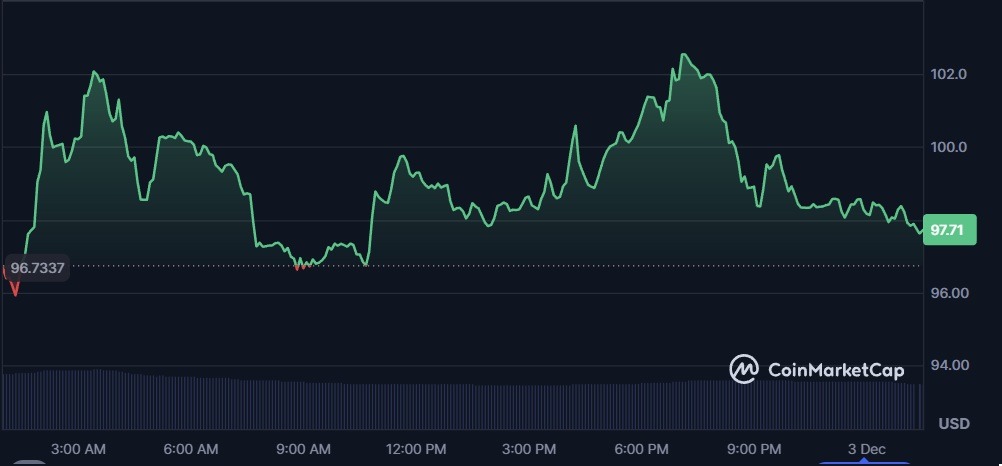
Currently, Quant is trading near 97 USD, which is around 24% higher than at the beginning of November 2025. Quant is a real-world asset (RAW) tokenization and digital asset infrastructure project.
Quant is a project building a blockchain agnostic interoperability layer called Overledger. It lets different blockchains and distributed ledgers connect and talk to each other while preserving their own security and performance. The native token is $QNT, and it powers the ecosystem, used for license payments, transaction fees, and access to other Overledger services. It was launched in 2018 and has been growing since then.
This sector is characterized by growing popularity among investors, and Quant’s interoperability was not overlooked by experienced crypto enthusiasts this month. Quant has been involved in CBDC and banking infrastructure efforts and has been recognized as a potential backend for regulated digital currencies and tokenized deposits in Europe and the UK.
$QNT recently cleared several of its key technical levels, which were supported by strong fundamentals. Some traders even view $QNT as a hedge against riskier altcoins, further increasing its attractiveness.
Monero $XMR (15%)
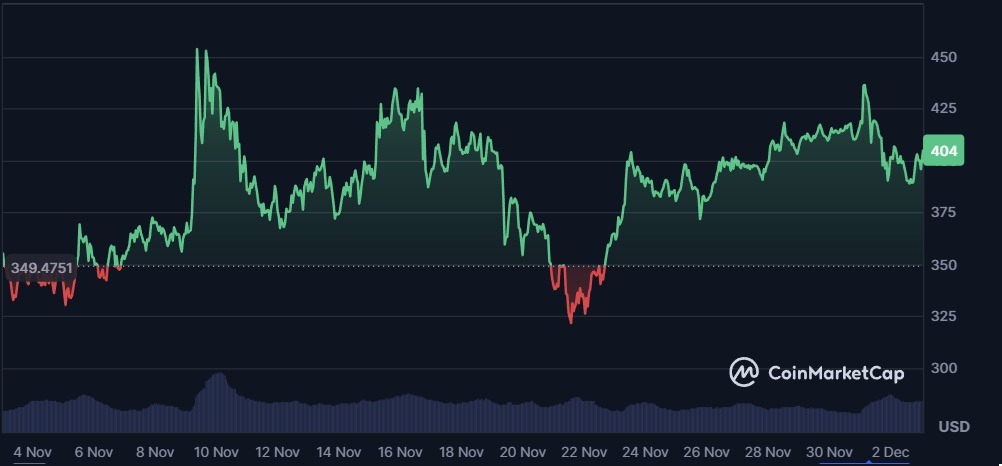
This month, Monero ($XMR) has risen by about 15%. Monero is a privacy-focused crypto project. Every transaction hides the sender, receiver, and amount by default, making it among the top privacy coins for anonymity. Due to its hidden nature, regulators have never liked $XMR, and it has struggled to grow in price. Many exchanges even delisted the token to align with the regulations.
Monero followed other privacy coins, which got increased investor attention in recent months, boosting its price as well. Technical breakout with strong volume also supported the overall bullish momentum. Despite its overall growth, the price started low, then rose, and then fell again, only to rise once again. This was a ranging behavior, but a fundamental driver (privacy coin focus) caused it to end up higher at the end of the month.
This was further amplified by the optimism around network improvements, noticeably about better privacy and security, reinforcing confidence in Monero’s fundamentals. Despite multiple challenges from regulators, $XMR maintains top positions in the privacy-oriented token space till today.
Kaspa KAS (11%)
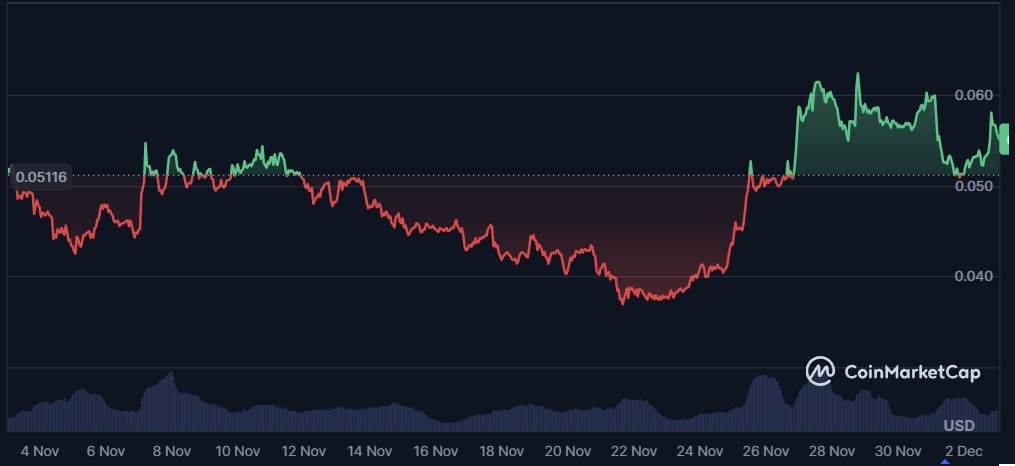
Kaspa continued its network improvements in November 2025 as well. The network has a high throughput, fast transaction confirmation times, and blockDAG scalability, making it technically competitive, attracting investors from different blockchains. Upcoming plans from Kaspa include smart contracts, layer-2 tools, and DeFi infrastructure, which increase its long-term utility and investor optimism. One BTC whale bought huge sums of Kaspa, which also contributed to the coin’s rise.
Kaspa introduced a decentralized bridge and was approved by Dimension, which improved its cross-chain utility and drew attention from market participants. As major cryptos recovered, altcoins like Kaspa also benefited, adding momentum to their price.
Kaspa is a POW (Proof of Work) crypto that uses the consensus algorithm, GHOSTDAG. Instead of a traditional single-chain blockchain, it uses blockDAG (Directed Acyclic Graph). As a result, multiple blocks can be produced and confirmed in parallel, increasing not only speed but throughput as well. In addition to these benefits, the network also offers a low-fee environment.
PAX Gold $PAXG (5%)
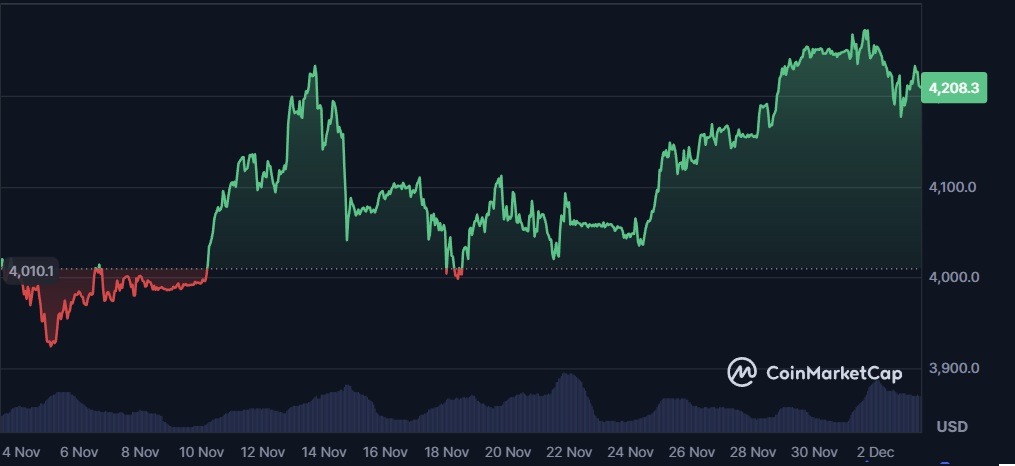
Crypto-backed crypto token, PAX Gold, was on a mild rise this month. Each $PAXG token represents ownership of one troy ounce of physical gold stored in secured, approved vaults. In other words, this is the true digital gold coin for investors.
PAXGrose in November for several reasons. The first reason is the rise of safe-haven demand among investors. As crypto volatility rises, gold-backed tokens like $PAXG become more attractive for investors to preserve the value of their capital. Couple this with an incredibly bullish year for gold, and all conditions were here for the token to rise in price. Tokenized gold was very popular this month as well because it enables investors to easily trade and own gold in the form of a digital coin. Because $PAXG trades like crypto, it offers 24/7 trading, making it easier and more accessible for crypto investors to own gold without lengthy procedures.
PACG is built on the Ethereum blockchain as an ERC-20 token, so you can hold, trade, or transfer $PAXG like any crypto token, but behind it is real gold, which gives it tremendous value. The price is above 4,200 USD. Token holders have the option to redeem their $PAXG tokens for physical gold bars or cash. So, it blends the stability of gold with the flexibility and liquidity of digital coins.
Top 5 Losers
On the other side, several robust projects struggled through November because of token unlock events, weak liquidity, ongoing selling pressure, and fading market narratives. These tokens indicated the sectors in crypto space where confidence remained low and where volatility hit hardest during the month. One thing was clear: token unlock events caused major selloffs from both retail and institutional investors, causing major downward price impulses for multiple tokens in this list.
Dash $DASH (-45%)
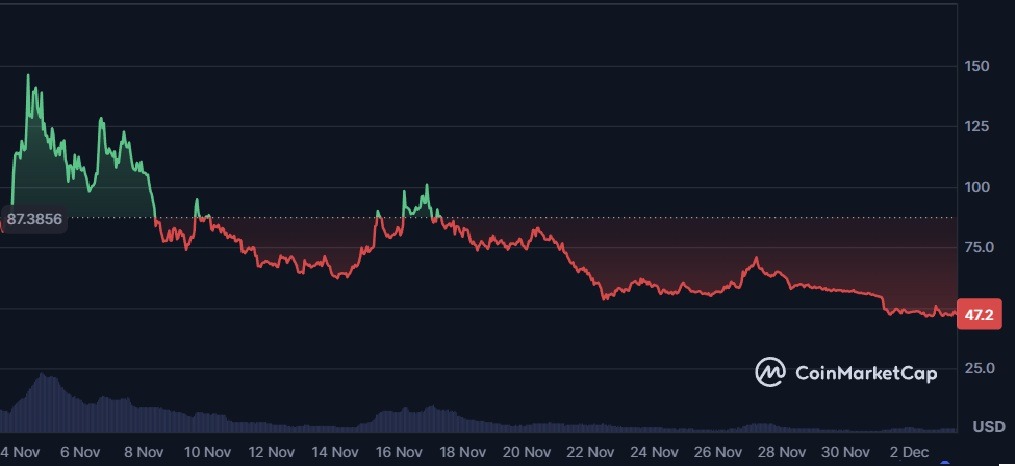
Dash is a privacy-focused coin that supports optional privacy, plus fast payments and masternode-based governance. The coin is a digital cash and supports mixing and CoinJoin features, hence, its superior privacy capabilities.
Dash fell almost 45% this month. After a while, capital moved away from some privacy coins as investors locked in gains, causing a reversal. Monero, which is a competitor to Dash, drew more attention and the coin underperformed as a result, suffering outflows. Derivatives trading for Dash showed growing short interest, and many traders were betting against $DASH, causing the downward momentum to accelerate. Dash surged massively in early November, making a 50%+ price spike. As a result, many traders who were in profit started to lock in profits. Despite the coin being a robust project, this downward pressure was greater than it could have been and made the coin tank nearly 45% hit. At the end of November, $DASH was trading near 47 USD per coin.
Aptos $APT (-39%)
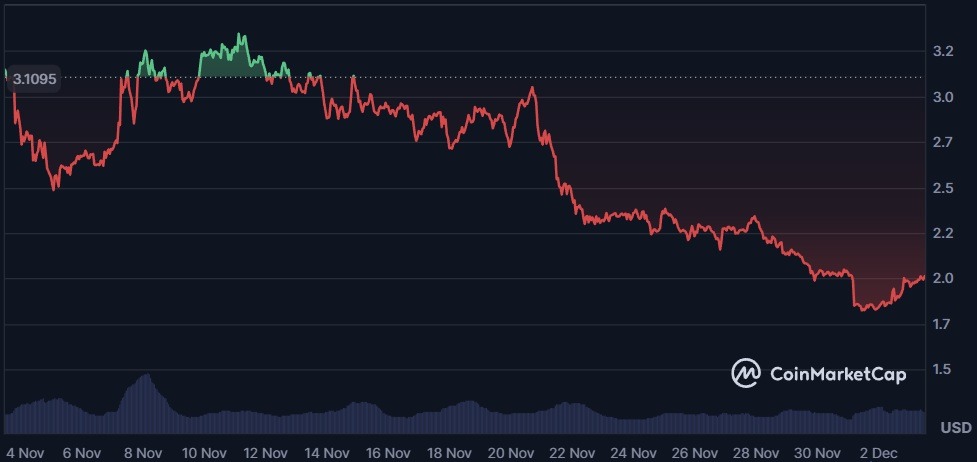
Aptos is a layer-1 blockchain network built for high speed, scalability, and secure smart contract execution. It has a parallel transaction engine and can execute many transactions at once. Its native token is $APT, which powers its ecosystem.
Despite healthy fundamentals and increased network activity, the $APT token saw a massive decline in November 2025. Several reasons contributed to the token’s depreciation. Early November saw a large market weakness and selloffs, as billions of dollars of leveraged positions were liquidated, pulling down many bitcoins, including the $APT token. The coin was unable to break major resistance zones, and it increased downward pressure. The demand and DeFi activities slowed down even though stablecoin supply grew on Aptos.
Recently, there were emissions and token unlock events, which caused the available supply to increase. This is usually a major bearish event, and it made things even worse for the token. As a result, it experienced a nearly 40% drop in one month, which would be catastrophic for any other financial markets, but is actually normal for altcoins.
Pepe $PEPE (-32%)
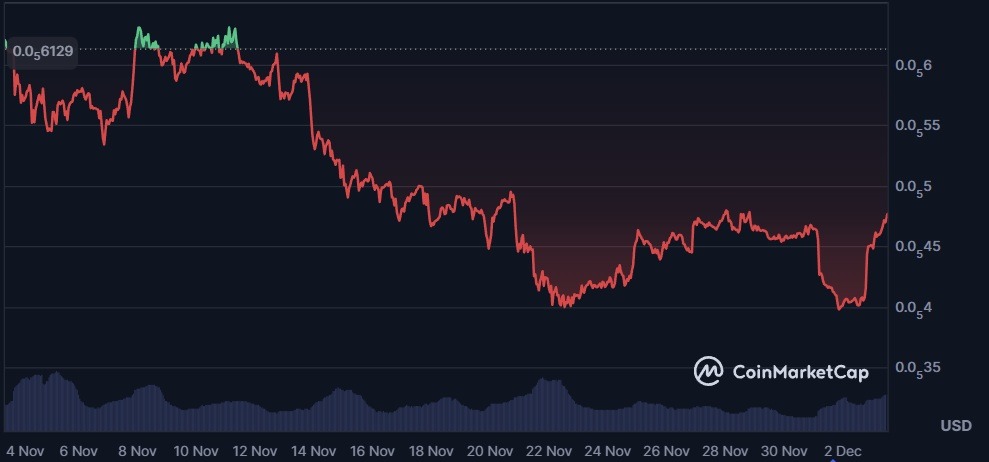
We usually avoid analyzing memecoins in our monthly reports, but we decided to include one meme coin in this month’s analysis. Pepe is a memecoin inspired by the popular internet frog meme. It does not have any real-world usage or functionality except for community and memes. Despite this, it has a 2 billion dollar market cap, which is higher than many robust and real projects in this analysis, showing how community hype can make anything really valuable.
Since it has no fundamentals to support its price, Pepe is heavily influenced by market trends and altcoin direction. In November, large Pepe holders moved trillions of $PEPE tokens onto exchanges, which is usually a clear sell pressure sign. Newer meme token projects like Little Pepe and many others emerged, and investors shifted their attention to new coins in fear of missing out, which only accelerated this capital outflow from $PEPE. The broader crypto market weakness and risk-off sentiment directly affected $PEPE because it has no strong fundamentals to support its position.
Eventually, $PEPE broke all key support levels, and coupled with declining futures open interest, we got a serious downward impulse.
Sui $SUI (-31%)
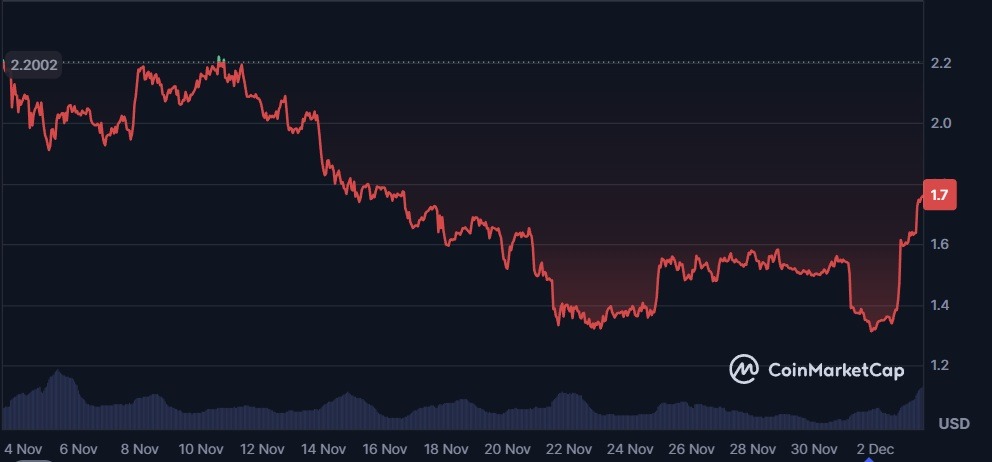
$SUI was down by 31%, which would be a major crash for any other financial asset. Sui is a layer-1 blockchain network developed for speed, scalability, and user-friendliness. It uses an object-oriented model, which enables independent transactions to be processed in parallel, giving near instant finality and low fees. Its smart contracts and assets are written in the Move programming language, which was developed for the Meta project, aimed at secure, efficient contract logic.
A large token unlock event is the main reason here, which caused the $SUI token to lose nearly a third of its value in just one month. Around $146 million worth of $SUI was unlocked, which caused a major sell-off before release. Investors who were holding $SUI sold their token to avoid getting caught in downward pressure caused by diluted supply, adding oil to the fire. Institutional selling was also a thing, with trading volume surging over 600% above average.
These bearish events were amplified even further due to broad crypto market weakness and large liquidations. Many tokens were hit, including $SUI, and there was a lack of strong buyer confidence after the drop, meaning the token was unable to recover quickly. Currently, the token is moving upward, and it might revisit the prior highs before these dramatic events, but caution is advised for crypto investors.
Toncoin $TON (-30%) & Polygon $POL (Prev. Matic, -30%)
Both $TON and $POL fell by nearly the same percentage in November, and we decided to analyze both of them. Both of these projects are major projects in crypto and are worthy of attention from crypto investors and enthusiasts.
Toncoin $TON -30%
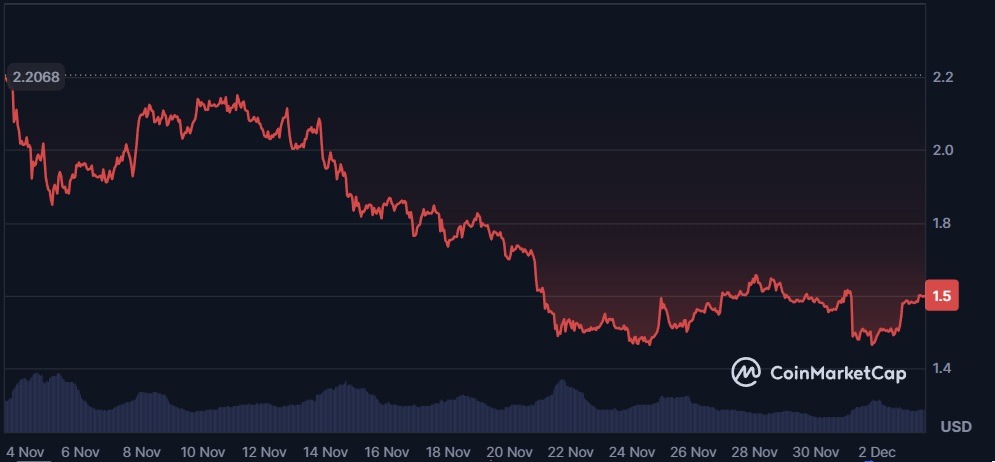
From 2.2 to 1.5, the $TON coin is struggling to recover after heavy losses. Originally associated with Telegram, the $TON coin project has come a long way since then, offering fast, low-cost blockchain infrastructure for payments, dApps, DeFi, NFTs, and other crypto services. A major $TON-holding firm, $TON Strategy Co., got a reprimand from Nasdaq for issuing stock without shareholders' approval to finance a large $TON purchase. As a result, a large panic-selling event was triggered, creating heavy selling pressure. Large positions were liquidated as a result, which accelerated the downward momentum, causing a nearly 30% loss in value for $TON coin.
Polygon $POL -30% (Prev. Matic)
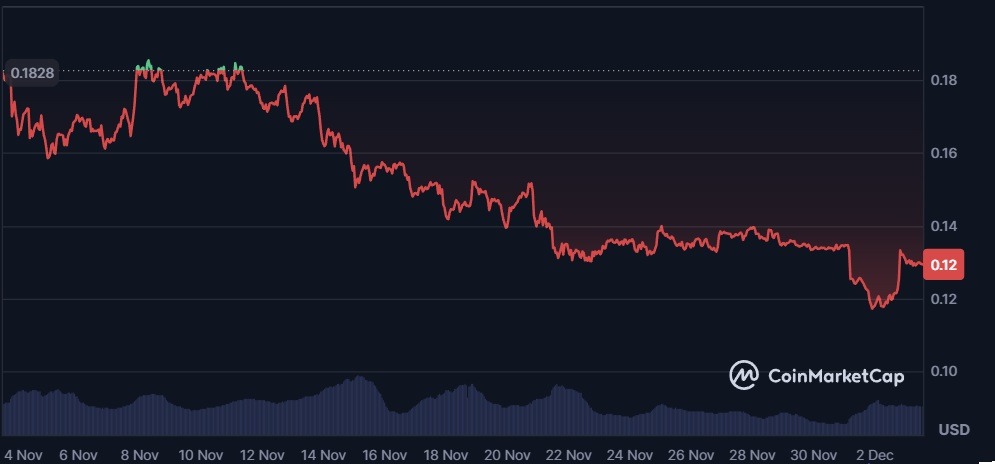
Polygon 2.0 upgrade in September 2024 migrated the token from MATIC to $POL, and this rebrand had several goals: reducing gas fees and adding staking, supporting validator roles, data-availability payers, sequencer decentralization, and revenue across multiple chains. In other words, $POL was transformed from a single sidechain to a full multi-chain, multi-layer ecosystem.
Despite all the efforts, the ecosystem experienced a slowdown in November and lost considerable market share in the process. New layer-2 protocols like Base and Arbitrum presented fierce competition to $POL, and they attracted more DeFi and $NFT investors. $POL’s upgrade introduced a 2% yearly emission, which added inflationary pressure seen as undermining token security, and decreased demand from crypto enthusiasts. Since overall market sentiment was also bearish and retail confidence fell, the token had a very strong sell pressure throughout the month.