
Crypto Exchange Fees Compared (2026): Maker, Taker, Token Discounts, and How to Get Trading Fees Back
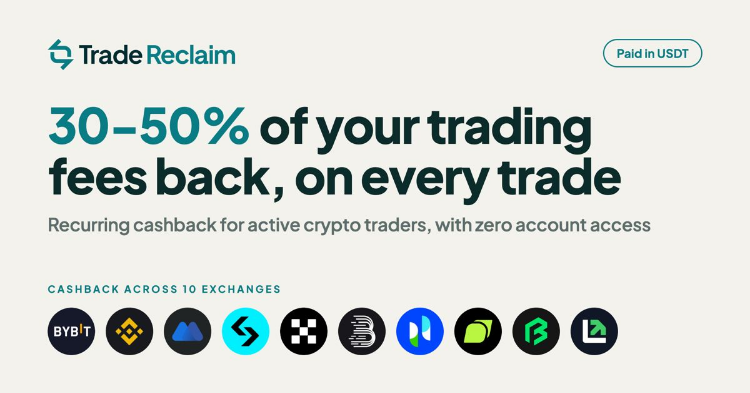
Crypto exchange trading fees range from about 0% to 0.60% on the maker side and 0.04% to 1.20% on the taker side, depending on the exchange, whether you trade Spot or Futures, and your 30-day volume. You lower them with 3 stacking levers: trade on a low-fee exchange, use the exchange’s own native-token discount and VIP volume tiers, and add a cashback rebate that returns a share of the fees you already paid. The first 2 levers cut the fee at execution; the third returns 30 to 50% of the fee afterward in USDT.
Fees verified June 2026 against official exchange fee schedules and Trade Reclaim’s published rates. Rates change; confirm the current number on the exchange’s own fee page before relying on it.
The 2026 crypto exchange fee comparison table
Below are standard-tier (VIP 0, lowest volume) Spot and Perpetual Futures fees, the native-token discount each exchange offers, and one notable perk. Maker is the rate for orders that add liquidity to the order book; Taker is the rate for orders that remove it.

Know when your
coins move
Alerts, real-time prices, and market news — all in one app
 4.8 based on 40K reviews in the App Store and Google Play


|
Exchange |
Spot maker |
Spot taker |
Perp maker |
Perp taker |
Native-token discount |
Notable perk |
|
MEXC |
0.00% |
0.05% |
0.01% |
0.04% |
MX holding discounts |
Lowest Spot maker (0%) |
|
OKX |
0.08% |
0.10% |
0.02% |
0.05% |
OKB holding discounts |
Deep liquidity across majors |
|
Binance |
0.10% |
0.10% |
0.02% |
0.05% |
25% off Spot with BNB |
Deepest overall liquidity |
|
Bybit |
0.10% |
0.10% |
0.02% |
0.055% |
None |
Strong derivatives venue |
|
Bitget |
0.10% |
0.10% |
0.02% |
0.06% |
BGB holding discounts |
Copy-trading |
|
KuCoin |
0.10% |
0.10% |
0.02% |
0.06% |
20% off paying in KCS (to ~0.08%) |
Large altcoin selection |
|
Kraken (Pro) |
0.25% |
0.40% |
0.02% |
0.05% |
None (no exchange token) |
Security and regulatory standing |
|
Crypto.com |
0.25% |
0.50% |
n/a* |
n/a* |
CRO Balance lowers fees |
CRO app ecosystem |
|
Coinbase (Advanced) |
0.60% |
1.20% |
n/a* |
n/a* |
None (no exchange token) |
US-regulated; 22 stablecoin pairs at 0% maker |
|
Gemini (ActiveTrader) |
0.60% |
1.20% |
n/a |
n/a |
None (no exchange token) |
US-regulated; select stablecoin pairs at 0% maker |
Methodology: figures are entry-tier (VIP 0) rates compiled from each exchange’s official 2026 fee schedule. MEXC, OKX, Binance, Bybit, and Bitget base rates are cross-checked against Trade Reclaim’s verified internal data.
*Perp columns marked n/a where a perpetual futures rate cannot be stated cleanly against the same product as the Spot row. Gemini ActiveTrader has no perpetual futures product. Coinbase’s Spot product here is Advanced Trade; Coinbase offers a separate US “perpetual-style futures” product under a different fee schedule, so it is not equated with the Advanced Spot row. Crypto.com publishes derivatives fees on a separate tier schedule; check its official derivatives page for your tier.
What is the difference between maker and taker fees?
Maker fees apply when your order adds liquidity to the order book; taker fees apply when your order removes it. A limit order resting below the current price is a maker order. A market order that fills instantly against existing orders is a taker order. Taker fees are usually equal to or higher than maker fees because exchanges reward orders that deepen the book.
The gap matters in practice. On Bybit Spot, both sides sit at 0.10%, but on Coinbase Advanced the entry tier is 0.60% maker against 1.20% taker, so using limit orders instead of market orders halves the fee. On Perpetual Futures the maker/taker spread is wider in relative terms: MEXC charges 0.01% maker against 0.04% taker, a 4x difference.
How do 30-day volume tiers work?
Every major exchange uses a rolling 30-day volume ladder: the more you trade in the trailing 30 days, the lower your maker and taker rate drops. Tiers recalculate continuously, so a busy month moves you down the ladder automatically and a quiet month moves you back up.
-
Kraken Pro scales from 0.25%/0.40% down to as low as 0.00%/0.05% at the highest published volume tiers.
-
Gemini ActiveTrader scales from 0.60%/1.20% toward roughly 0.00%/0.02% at the highest published tiers.
-
Binance, OKX, Bybit, Bitget, KuCoin, and MEXC all run VIP ladders that push fees toward about 0.02%/0.04% maker/taker at high tiers.
Volume tiers reward scale, which means most retail traders sit at VIP 0 and never reach the headline-low rates the venues advertise.
What are the hidden spreads on “instant buy” buttons?
The “instant buy” or “convert” button on most exchange apps carries a built-in spread of roughly 1 to 2%, which is separate from and far larger than the maker/taker fee on the trading screen. That spread is the real cost of the convenience flow, and it does not appear as a line-item fee.
A trader paying 0.10% on the Spot trading screen can pay 10 to 20x that on the same asset through the instant-buy widget. The practical rule: use the actual Spot or Futures order book with limit orders, not the one-click convert button, whenever fees matter.
Three ways to lower your crypto trading fees
Fee reduction stacks across 3 independent levers. The first 2 lower the fee at execution. The third returns part of the fee after the trade. They combine because each operates on a different part of the cost.
Lever 1: Trade on a low-fee exchange
Base fees differ before any discount, so the venue is the foundation. On the table above, MEXC (0%/0.05% Spot, 0.01%/0.04% Futures) and OKX (0.08%/0.10% Spot, 0.02%/0.05% Futures) sit at the low end, while Coinbase Advanced and Gemini start at 0.60%/1.20% Spot. Choosing the right venue for your product (Spot vs Futures) sets the ceiling on everything below.
Lever 2: Use the exchange’s own discounts
Two standard tools cut the published rate:
-
Native-token discounts. Holding or paying fees in the exchange’s token reduces the rate. Binance gives 25% off Spot fees paid in BNB; KuCoin gives 20% off when fees are paid in KCS, taking 0.10%/0.10% down to roughly 0.08%/0.08%; OKX (OKB), Bitget (BGB), and MEXC (MX) run holding-based reductions; Crypto.com lowers fees as your CRO Balance rises.
-
Volume tiers. The 30-day ladder above. Real savings that scale with how much you trade.
These are the exchange’s own levers, and they are genuine. Their limit is that they only ever reduce the fee on the fee schedule.
Lever 3: Cashback on the fees you already paid
The third lever is the one most fee comparisons leave out: a cashback rebate that returns a share of the trading fees you already paid, credited afterward in USDT. It works on the commission side, not the fee schedule, so it stacks on top of levers 1 and 2.
Here is the mechanism, because “get money back on fees” deserves an explanation. Exchanges run affiliate programs and pay a commission on referred accounts. A cashback service signs you up through its affiliate link, the exchange tags your account as referred, you enter your public UID, and the service identifies you inside the exchange’s official affiliate dashboard. From then on, the exchange pays the service a commission on your fees, and the service returns a share of that commission to you. Nothing is taken from the exchange beyond what it was already paying out, and the fee on your trade is still charged in full at execution; the rebate arrives separately afterward.
Trade Reclaim is the worked example of this lever. It returns 30 to 50% of trading fees in USDT across 10 exchanges (Bybit, Binance, MEXC, Bitget, OKX, BitMart, Phemex, Bitunix, BloFin, and LeveX), recurring on every trade for as long as the account stays linked. Published rates are 30% on Bybit, Binance, MEXC, Bitget, OKX, Phemex, and BloFin; 35% on Bitunix and LeveX; and 50% on BitMart, the highest. It works only from your public UID: it never holds funds, has no trading or withdrawal access, and never asks for a password or API keys. Your money stays on your own exchange account.
Worked example: a 0.055% Taker fee on a Bybit Perpetual Futures position is charged in full at execution. A 30% cashback then returns 0.0165% of the notional to you in USDT after the trade. That rebate lands on top of any VIP-tier or token discount you already have, because it comes from the commission the exchange pays out, not from the rate on your trading screen.
The honest tradeoff: cashback does not make the execution price cheaper, and it does not replace token or volume discounts. It is a separate USDT credit on fees already paid, and its value scales with how much you trade.
FAQ
Which crypto exchange has the lowest trading fees? At standard VIP 0, MEXC has the lowest Spot maker fee at 0% (0.05% taker) and the lowest Futures rates at 0.01%/0.04%. OKX is next at 0.08%/0.10% Spot. US-regulated venues like Coinbase Advanced and Gemini start highest, at 0.60%/1.20% Spot. The “lowest” venue depends on whether you trade Spot or Futures and on your 30-day volume.
What is crypto trading fee cashback? Crypto trading fee cashback is a rebate that returns a percentage of the trading fees you already paid, credited back to you after the trade as a separate USDT payment. It comes from the affiliate commission the exchange pays a referring service, so it is independent of your exchange’s own fee tier and stacks on top of token and volume discounts.
How can I reduce my crypto trading fees? Use 3 stacking levers: trade on a low-fee exchange, apply the exchange’s native-token discount (BNB, KCS, BGB, OKB) and reach lower 30-day volume tiers, and add a cashback rebate that returns 30 to 50% of fees in USDT. Also use limit (maker) orders instead of market (taker) orders, and avoid the instant-buy button, which carries a 1 to 2% spread.
Are crypto cashback services safe? A cashback service that works only from your public UID never holds your funds and has no trading or withdrawal access to your account. The mechanism relies on the exchange’s official affiliate dashboard, not on a connection to your trading account: you never share a password or API keys, and your money stays on your own exchange account. Verify that any service uses this UID-based model before linking.