
 coindesk.com
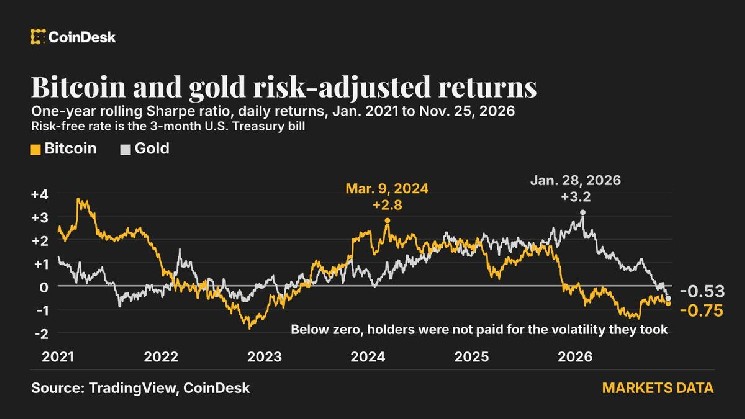
For most of the past year, gold has held an edge over bitcoin BTC$58,586.33 as a haven asset, with positive risk-adjusted returns rather than the negative values offered by the largest cryptocurrency.
That edge has vanished, and gold is now also failing to compensate holders for the price volatility they’ve taken on.
To see why this matters, start with how investors decide which assets to hold. When they take on extra risk, they expect a greater reward. Stocks, for example, ought to provide higher returns in terms of capital growth and dividends than government-issued debt.
One standard yardstick is the Sharpe ratio, which measures an asset's return over and above the yield on the U.S. three-month Treasury bill, considered a risk-free investment, divided by its volatility. A positive reading means investors were compensated for taking on a bumpier ride, a negative value means they were not.
According to CoinDesk calculation, gold’s one-year Sharpe ratio was recently at -0.53 and that for bitcoin, considered by some observers as digital gold, was -0.75. That means neither is compensating investors for their volatility relative to high-yielding, highly liquid, near-cash equivalents. In other words, they indicate a investor dash for cash.
The convergence in metrics, however, does not reflect convergence in the underlying fundamentals of the precious metal and the digital currency. Rather, it points to a cyclical shift in how capital is being allocated, according to HashKey Group’s senior researcher, Tim Sun.
"A decline in gold’s Sharpe ratio does not mean Bitcoin is becoming a superior safe-haven asset,” Sun told CoinDesk. “On the contrary, it likely signals that investors are reassessing the allocation value of the entire non-yielding asset class. Consequently, the primary competition facing both gold and Bitcoin right now may not be each other, but cash-equivalent assets and high-grade bonds capable of offering relatively certain yields."
Gold’s rapid deterioration
Historical data highlights just how fast the landscape has shifted this year.
Gold's one-year rolling Sharpe ratio had remained comfortably positive since April 2023, apart from a two-day dip in January 2024, and peaked at an extraordinary 3.2 on Jan. 28, 2026.
For bitcoin, it’s been negative since November, and peaked at 2.8 in March 2024.
“The chart doesn't show that bitcoin has matured into digital gold. If anything, it shows gold converging down toward bitcoin in terms of trailing risk-adjusted returns, after an exceptional trend in gold reversed sharply,” Griffin Ardern, co-founder and portfolio manager at Primal Fund, told CoinDesk.



