
 coindesk.com

Last week, crypto users in Venezuela and certain other jurisdictions were blocked from accessing MetaMask and, ultimately, the Ethereum blockchain.
The core issue ended up being with Infura, a crypto software and API provider that plays one of the largest roles in providing infrastructure for on-chain wallets and decentralized applications. While Infura said the ban was in accordance with legal standards and global sanctions and not a blanket ban, many noted that even the ability to block access poses a threat to the decentralization of the ecosystem.
So what are the potential solutions?
-
Industry-level change – use decentralized API providers, create hundreds of options that are geographically diversified
-
Protocol-level change – allow anyone to run a node on a simple computer and access the blockchain locally
The former is essential in addressing some of the concerns laid out by Moxie Marlinspike a few months ago and ultimately in pushing the industry forward to reaching actual decentralization. Marlinspike noted that unless users or applications are running their own node, they are completely relying on third parties like Infura and Alchemy to interact with the blockchain for them.
The latter is something that Vitalik Buterin has been discussing since 2017. The concept of “Stateless Ethereum” would help remove the reliance on centralized service providers and would allow blockchain users to access the chain locally in dire situations, especially if they are being blacklisted. To understand Stateless Ethereum, it is vital to understand the problem, as broken down by Ethereum researcher Sandra Johnson of ConsenSys:
“The Ethereum world state contains all Ethereum accounts, their balances, deployed smart contracts and associated storage. New accounts are continually being added and new smart contracts are being deployed. Therefore, by design, the state size of Ethereum keeps growing ad infinitum. The implication of this unbounded state growth is that it takes longer and uses more space to spin up a new full node.”
The Ethereum Foundation sums up some of the reasons to run an Ethereum node as follows:
Open comms
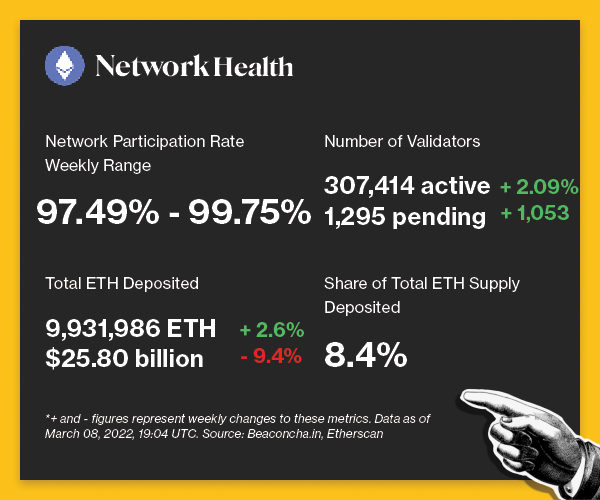
Valid Points incorporates information and data about CoinDesk’s own Eth 2.0 validator in weekly analysis. All profits made from this staking venture will be donated to a charity of our choosing once transfers are enabled on the network. For a full overview of the project, check out our announcement post.
You can verify the activity of the CoinDesk Eth 2.0 validator in real time through our public validator key, which is:
0xad7fef3b2350d220de3ae360c70d7f488926b6117e5f785a8995487c46d323ddad0f574fdcc50eeefec34ed9d2039ecb.
Search for it on any Eth 2.0 block explorer site.