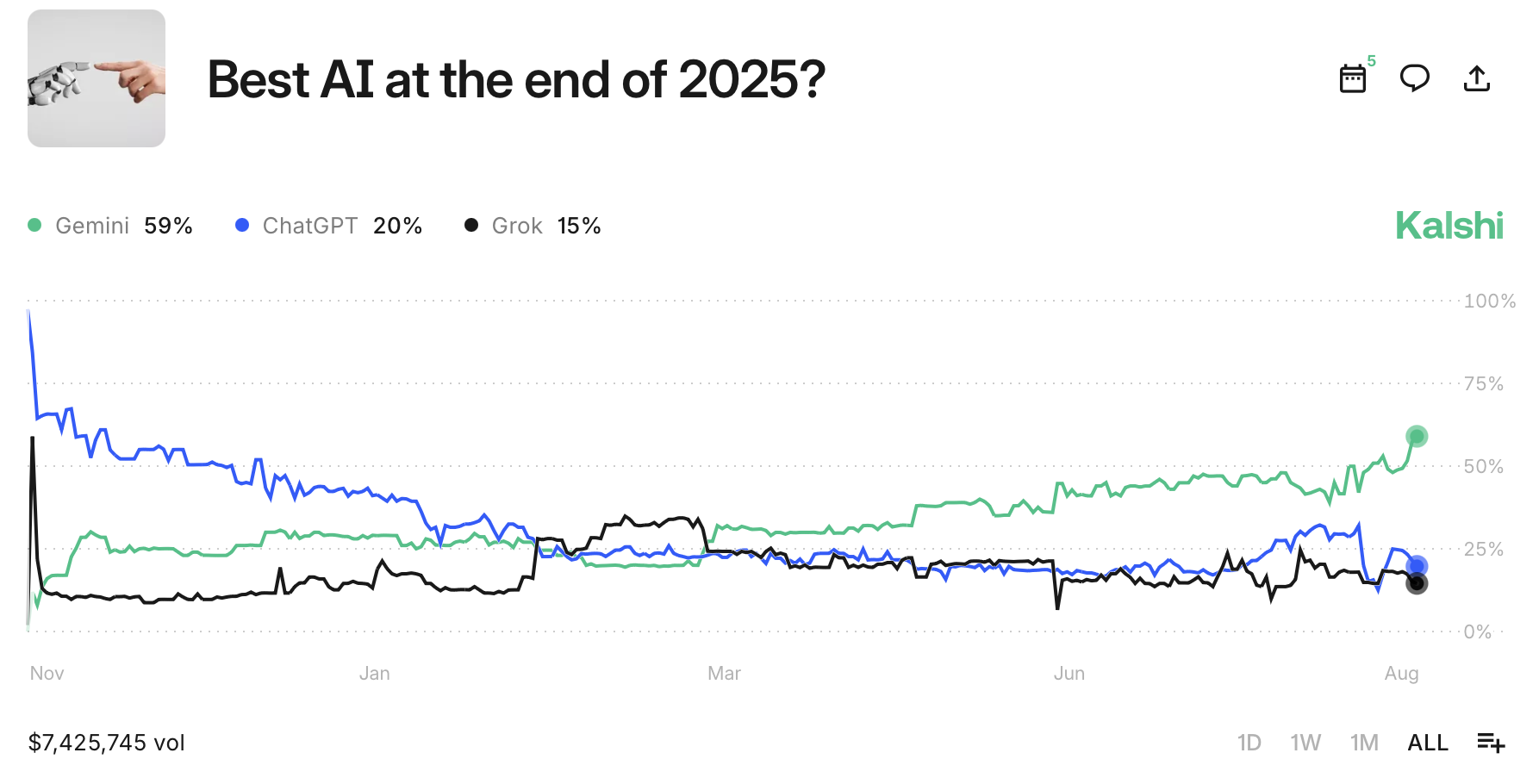
Kalshi’s best AI model of 2025 prediction scenario. Source: Kalshi
On Aug. 15, Google announced a series of updates for Gemini, including a storybook mode, an improved reasoning model and temporary chats that aren’t saved in the user’s history. Meanwhile, OpenAI has suffered missteps, including a rollout of ChatGPT-5, which users panned and the company CEO, Sam Altman, had to take to X to defend.
XAI’s Grok has had well-publicized problems as well, with users accusing the model of being either biased to the right wing or left wing of politics, depending on the user. The company was forced to delete certain Grok posts after the model allegedly praised Adolf Hitler.
Related: Bitcoin miners and AI firms compete for cheap sustainable energy
LLM race heats up
The pursuit to become the world’s top large language model has heated up in recent months as the industry vies for position in various domains.
One of those domains is internet search, where many AI models draw their information and sources. Last Tuesday, AI company Perplexity made a $34.5 billion unsolicited cash offer to purchase Google’s Chrome browser, which holds the majority share in the internet browser market. OpenAI is reportedly interested in buying the browser as well.
DeepSeek, an AI company based in China, has gained market share. In April, it released a new model called Prover 2, which is advanced in mathematics.
However, there could be barriers to AI development through anti-trust actions. In October 2024, G7 nations’ anti-trust authorities indicated that they might take action to protect competition in the AI field. Both Google and Meta, players in the AI industry, are facing antitrust lawsuits — Google from a US District Court and Meta from the Federal Trade Commission. These lawsuits could affect AI development.
Magazine: AI Eye: Everybody hates GPT-5, AI shows social media can’t be fixed

 cointelegraph.com