“United States electricity demand is expected to grow at an extraordinary pace, due, in large part, to the rapid growth of large loads,” Wright wrote.
“Although there are several drivers to this demand growth, such as home and vehicle electrification, increasing quantities of large commercial and industrial load, most notably data centers, are connecting rapidly to the transmission system.”
Bitcoin miners and AI centers would benefit
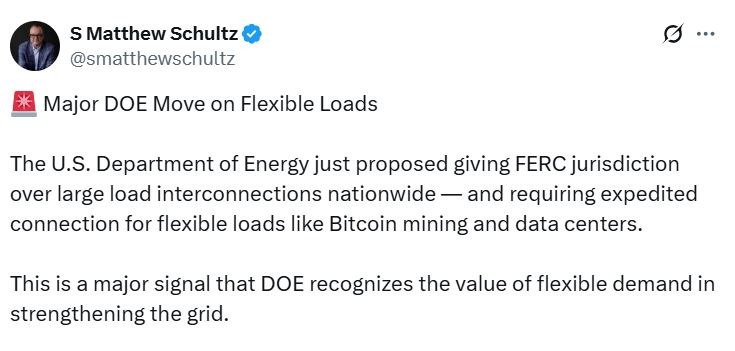
S. Matthew Schultz, the CEO of Bitcoin mining company CleanSpark, said in an X post on Friday, that under the rules, FERC would be required to expedite connections for “flexible loads like Bitcoin mining and data centers.”
“This is a major signal that DOE recognizes the value of flexible demand in strengthening the grid,” he said.
Source: S. Matthew Schultz
Bitcoin miners require significant power to operate their mining rigs, which validate transactions and create new blocks. The more miners participate, the higher the hashrate, which helps secure the network.
Reviews could only take 60 days
Under the new rules, Wright suggests that expedited reviews on whether large power users can connect would be completed in 60 days, instead of years, provided the applicant meets criteria such as agreeing to pay for any network upgrades that might be required.
Related: Bitcoin mining just got easier — but not for long, as hashrate roars back
Wright asks that FERC respond to his letter within the next six months, no later than April 30, 2026.
Bitcoin mining companies and artificial intelligence data centers have been increasingly competing for access to cheap, sustainable energy, which has been suggested could bring in renewed institutional investment over the next decade.
Magazine: Binance shakes up Korea, Morgan Stanley’s security tokens in Japan: Asia Express

 cointelegraph.com