
 cryptonews.net

The Law Commission of England and Wales has put forth suggestions for modernizing the regulation of virtual possessions. The newly proposed Electronic Money Regulations will govern digital assets resembling securities, enhancing security and transparency in the crypto asset market within the United Kingdom.
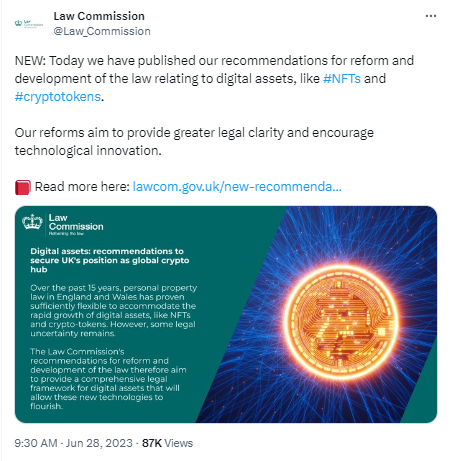
Snapshot | Source: Twitter
The United Kingdom aims to establish sensible regulations about cryptocurrencies
The utilization of crypto tokens (cryptocurrencies), non-fungible tokens (NFTs), and other digital assets is experiencing a surge in contemporary society. These instruments serve various purposes: investment, payment transactions, and representing debts and equities.
Over the past 15 years, English and Welsh personal property law has evolved to encompass digital assets. However, certain gray areas still exist due to the dynamic nature of the digital asset market and associated technologies.
Given the challenges posed by emerging technology, the Government of England and Wales assigned the Law Commission to examine the existing legal framework. Based on the resulting recommendations, this novel study will be a foundation for regulating digital assets.
The government anticipates future digital assets' flourishing by implementing these new regulations. These proposed measures will enable a wide range of market participants to engage with and reap the benefits of these groundbreaking technologies, establishing a robust legal framework.
According to the commission's findings, the standard law system in England and Wales is well-prepared to provide an extensive and globally applicable framework for existing and new types of digital assets.
Digital assets, due to their intangible nature and unique characteristics, cannot be easily classified as tangible assets like real estate or rights-based assets like debts or securities.
However, the commission argues that the adaptable nature of the common law allows for creating a distinct category under personal property law, which can better identify and safeguard the unique attributes of digital assets. Moreover, the commission's proposed legislation suggests formalizing this classification to eliminate ambiguities.
Facilitating the Expansion of Digital Assets
The Law Commission recommends that the government assemble a panel of industry experts to assist courts in handling the complexities associated with new technology. This group is expected to provide valuable guidance on technical and legal aspects of digital asset regulation.
Furthermore, the commission's recommendations aim to grant market players in England and Wales access to legal procedures currently unavailable. This includes exploring novel approaches to safeguarding cryptocurrency tokens and tokenized securities.
The commission's proposed changes aim to establish a unified and transparent system for digital assets, benefiting consumers and businesses by enhancing security and promoting transparency.
These suggestions align with the government's objective of fostering technological advancements, further solidifying England and Wales as a prominent hubs for crypto tokens and assets worldwide.
United Kingdom's Drive for Widespread Cryptocurrency Adoption
The United Kingdom has adopted a systematic approach to crypto regulation over the years. Concerns regarding the absence of crypto regulation were initially raised in 2014, leading to establishing of the "Guidance on Cryptoassets" in 2019.
Within the cryptocurrency ecosystem in the United Kingdom, these assets are referred to as "crypto assets," serving as a broad term for various forms of digital currency.
The Financial Conduct Authority (FCA) serves as the primary financial regulator, overseeing crypto asset enterprises to ensure the implementation of robust anti-money laundering measures.
While custody of crypto assets necessitates registration under the UK Money Laundering Regulations, these assets remain unregulated.
The United Kingdom is conducting public hearings regarding adopting the EU's Markets in Crypto Assets Regulation (MiCA)-aligned complete financial services regulatory license for crypto industry players. The Electronic Money Regulations (EMRs) will introduce new rules applicable to digital currencies and assets resembling securities.
Our proposed recommendations revolve around the reformation and development of legislation to provide stronger support for digital assets. We also strive to maintain a modern, internationally competitive, and adaptable private law system in England and Wales. Therefore, we are updating our laws to reflect the evolving nature of digital property, facilitating and smoothing the path for future technological advancements.
Professor Sarah Green, the Commissioner for Commercial and Common Law, asserts that the value and prevalence of digital assets have surged in recent years. England and Wales's flexible standard law system can accommodate this rapid growth.