Some argue that the MiCA facilitates businesses growth in the region, while others focus on the privacy risks for personal users’ data, and the risks imposed for non-custodial solutions, including decentralized finance (DeFi) applications.
The drop in DApp deposits is concerning
The Ethereum network is experiencing problems caused by surging gas fees, the cost associated with transactions, including those performed by smart contracts. For the past 4 weeks, the average transaction fee has stood above $9, which severely limited the demand for DApp usage.
Total deposits on the Ethereum network in Ether terms plunged to their lowest levels since August 2020. Such an analysis excludes the effects of native Ethereum staking, which recently started to allow withdrawals.

Ethereum network applications' total deposits in $ETH. Source: DefiLlama
According to DefiLlama data, Ethereum DApps reached 14.9 million $ETH in total value locked (TVL) on May 16. That compares with 16.5 million $ETH two months prior, a 10% decline. As a comparison, TVL on $BNB Smart Chain in $BNB terms was essentially flat in the same period, while Polygon network’s (MATIC) deposits increased by 29%.
$BNB Smart Chain attempts to take a lead in DEX volume
Ethereum might have been the absolute leader in DEX volumes since inception, but this position is being challenged. Ethereum’s market share by volume on decentralized exchanges (DEXs) peaked at 75% in the week ending March 5 but steadily declined to its lowest level ever, at 39.6% in the week ending May 14.

Weekly DEX volume by chain. Source: DefiLlama
Gainers on DEX trading volumes were Arbitrum, increasing to 14% from 7%, and $BNB Smart Chain, growing to 31% from 5.6% since March 5. One might argue that the success of the Ethereum network’s scaling solutions reflects bullishness for Ether’s price, but that relationship is not so direct.
Data shows pro traders turning bearish
Ether quarterly futures are popular among whales and arbitrage desks. However, these fixed-month contracts typically trade at a slight premium to spot markets, indicating that sellers are asking for more money to delay settlement.
As a result, $ETH futures contracts in healthy markets should trade at a 5 to 10% annualized premium — a situation known as contango, which is not unique to crypto markets.
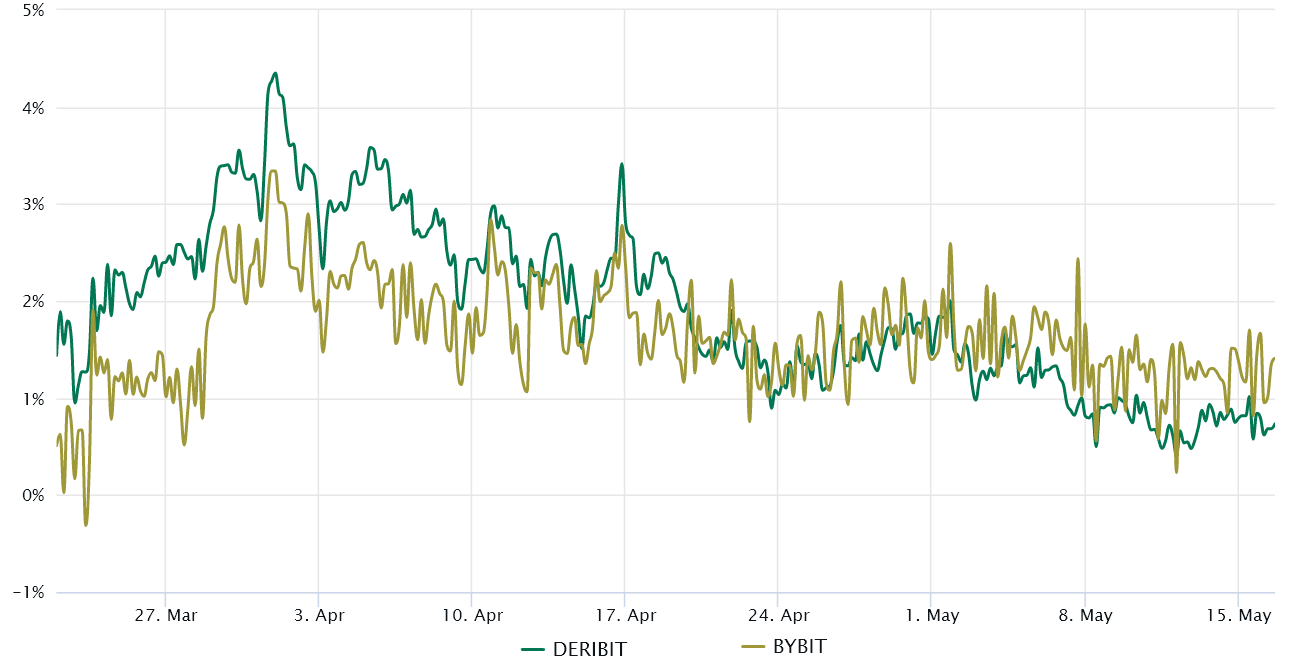
Ether 3-month futures annualized premium. Source: Laevitas
Ether professional traders have avoided leverage longs (bullish bets) since early April. Moreover, the current 1% $ETH futures premium is on the edge of becoming negative, known as backwardation — if confirmed, this is an alarming red flag as bearish demand dominates the scene.
In short, those 3 indicators signal the $1,900 resistance will be hard to break in the short-term, namely the reduced TVL, record-low DEX market share, and lack of leverage buying demand. For now, Ether bears are in control, favoring the odds of a price correction.

 cointelegraph.com