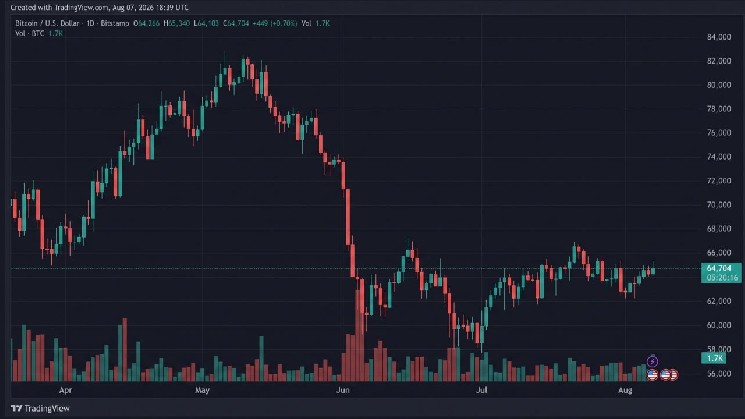
Despite the relatively flat price action, the movement pushed bitcoin’s market capitalization back past $1.3 trillion. The marginal daily gain capped off a 3.3% weekly rise during a turbulent period in which controversy over the CLARITY Act reached a crescendo.
In the derivatives market, short liquidations topped $30 million for the second consecutive day, while long liquidations neared $8 million. Across the broader crypto economy, total liquidations hit $192 million, with short wipes accounting for just under $112 million.
Meanwhile, hopes for the passage of the CLARITY Act before the U.S. Senate recess were dashed when Senate Majority Leader John Thune announced plans to revisit the topic in September. While a setback for the crypto industry—which had framed the bill as a crucial milestone under the Trump administration—some market participants brushed off the potential negative impact.
However, regulatory debate was not the only issue shaping discussions around Bitcoin’s future. The controversial BIP 110 proposal reached a fever pitch after prominent Core developer Luke Dashjr suggested on X that if BIP 110 fails to gain traction, changing Bitcoin’s proof-of-work (PoW) consensus mechanism would be “the only option”—a stance that underscored the growing risk of a potential chain split.
“If BIP110 doesn’t pan out, the only option is a PoW change,” he wrote on X when asked about the proposal’s potential failure.
Others warn that if miners don’t back the proposal, this has deep implications for bitcoin, which has retained its status as the number one decentralized network despite challenges including the 2017 hard fork.
Echoing the urgency, itcoiner Nithu Sezni asserted that if miners refuse to activate BIP 110, bitcoin effectively becomes a centralized “shitcoin.” Sezni argued that if six major mining pools can block the proposal and collude to dictate network rules, decentralization is lost—leaving node runners vulnerable to blockchain bloat and state capture before hyperbitcoinization can occur.
Still, much like the legislative back-and-forth over the CLARITY Act, the BIP 110 debate appears to have had a limited impact on bitcoin’s price. In fact, some market observers suggest bitcoin’s upward trend ahead of the BIP 110 deadline is driven by investors accumulating coins in anticipation of a potential hard fork—a scenario that would automatically grant them equivalent tokens on the split chain.

 news.bitcoin.com