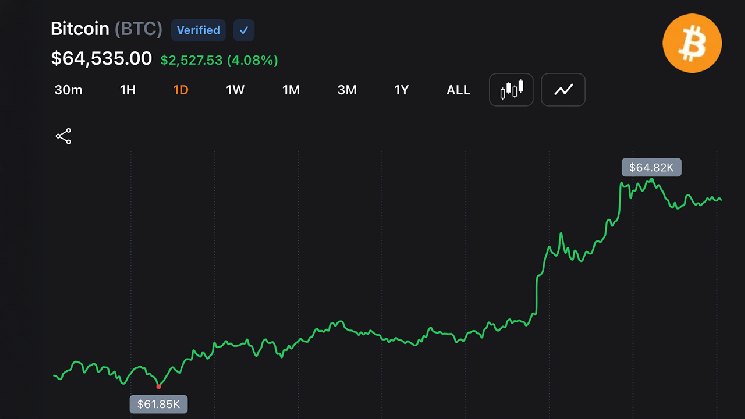
Bitcoin has since retreated to just under $64,500, a 24-hour gain of 4.2%. The unexpected surge lifted its market capitalization past $1.29 trillion, pushing the aggregate crypto market cap over the $2.3 trillion mark.
On the derivatives market, bitcoin’s price action in the 24-hour period was brutal for short traders. Coinglass data showed the rally triggered the liquidation of $105 million in short bets, compared with $8 million in long bets. Overall, liquidations across the cryptocurrency market reached approximately $377 million, with liquidated short bets accounting for $277 million of the total.
Although a third night of strikes by the U.S. military on Iranian targets further pushed up oil prices, markets got a tailwind from the latest Consumer Price Index (CPI) data, which showed June inflation dropping to 3.5% year-over-year. This lower-than-feared inflation relieves immediate pressure on the Federal Reserve to keep hiking rates, causing bond yields to ease and stabilizing equity indexes.
However, with the situation in the Middle East continuing to deteriorate, the prospects of inflation dropping again in July appear dim. Already, oil prices—one of the key drivers of the May inflation surge—have slowly climbed to levels last seen a few weeks before the U.S. and Iran announced a breakthrough in negotiations. As of 2:44 p.m. EDT, Brent crude, which reached $87 a barrel earlier in the day, traded a few cents below $85 a barrel, while the U.S. benchmark, West Texas Intermediate, was just under $80 a barrel.
According to experts, the renewed hostilities sparked by disagreements over the status of the Strait of Hormuz have effectively ended the oversupply narrative and revived fears of a global oil shortage. These shortages are seen as undercutting any lingering hopes for a Federal Reserve rate cut. For bitcoin, the prospects of steeper rate hikes dash any hopes of reclaiming $100,000 by year-end.

 news.bitcoin.com