That shift intersected with a contentious corporate action. “Recently, Saylor sparked controversy by revealing that Strategy had revised its MSTR Equity ATM Guidance to offer greater ‘flexibility’ in executing its capital markets strategy.” The implication, Deutscher argues, is that greater issuance flexibility “may dilute shareholder value and increase financial risk tied to Bitcoin’s volatility.”
He notes that “the market is quite divided” on the change. On the constructive side, he quotes @thedefivillain’s take—“Slower concentration of supply in Saylor’s hands,” “Greater leverage to justify mNAV,” and “Reduced buying pressure for $BTC in dollar terms”—as reasons the revision could ultimately be benign.
But critics worry about “the possibility of a ‘death spiral.’ The removal of the 2.5x mNAV safeguard for equity issuance may allow MicroStrategy to sell shares at lower valuations.” Reflexivity, in Deutscher’s telling, is the operative risk factor: “Reflexivity is a brutal force that operates in both directions.”
A Hypothetical Scenario
Deutscher then sets up a stress-test to illustrate how that reflexivity could bite if Bitcoin weakens and the premium compresses to parity. “If $BTC’s price drops 20% and MicroStrategy’s mNAV multiple falls to 1.0x, the stock might plummet by 46.5%.”
He walks through the arithmetic from a notional baseline of $115,000 per $BTC, which on a 20% decline would fall to $92,000. On MicroStrategy’s “226,331 $BTC,” he calculates that would put look-through NAV at $20.82 billion.
To align an mNAV of exactly 1.0x, he backs into enterprise value and market cap under that scenario: “Starting with an enterprise value of $20.82 billion, we subtract MicroStrategy’s $2.2 billion in debt and add its $0.1 billion in cash. This calculation unveils the company’s market cap, hitting $18.72 billion, a significant pullback from its original $35 billion market cap.”
The conclusion he draws from the modeled path—$BTC −20% to ~$92,000, mNAV → 1.0x, MSTR market cap −46.5%—is that MicroStrategy’s equity remains a leveraged instrument with an outcome path that can be materially worse than Bitcoin itself when the premium compresses.
Beyond the scenario math, Deutscher links recent spot price action to changing marginal demand. “I think $BTC’s recent weakness can be attributed to the market starting to price in reduced Saylor demand/tail potential risk of the revised ATM guidance.”
In parallel, he highlights how the proliferation of spot ETFs erodes the original rationale for paying a large listed-company premium to own $BTC “beta”: “Spot Bitcoin ETFs are plentiful now. Why would you pay a 58% premium for MSTR’s leveraged exposure when you can grab IBIT at a clean ~1.0x NAV?”
By his framing, the mNAV premium itself “was indicative of the market’s view that MSTR was going to outperform $BTC.” With that view fading, the premium looks less like an enduring structural feature and more like a belief-sensitive variable. “In my opinion, the MSTR premium is essentially a gamble. You’re betting on three fragile things: unwavering market confidence, open capital markets, and Saylor’s leadership. If any of those pillars start to wobble, the premium collapses.”
At press time, $BTC traded at $113,624.
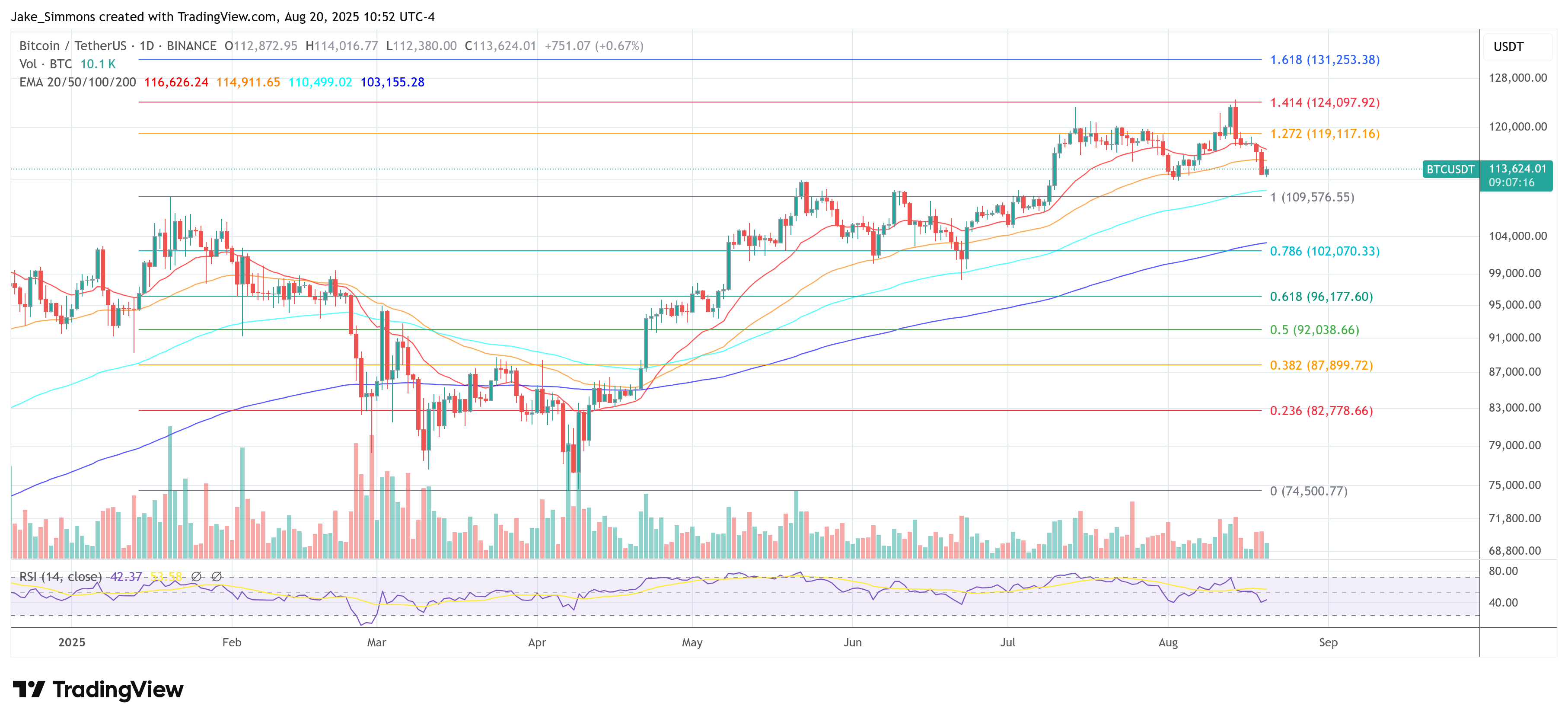
Featured image created with DALL.E, chart from TradingView.com

 newsbtc.com