Foreign exchange (FX) settlement could be the largest untapped opportunity, according to the report. The $7.5 trillion-a-day FX market still largely settles on a T+2 basis through correspondent banks. Meanwhile, on-chain FX using stablecoins could enable atomic swaps with near-instant settlement and lower counterparty risks, the report suggested.
Such efficiencies could also transform cross-border payments. With more regulatory clarity, greater liquidity and interoperability, stablecoins could handle as much as 12% of all cross-border payment flows by the end of the decade.
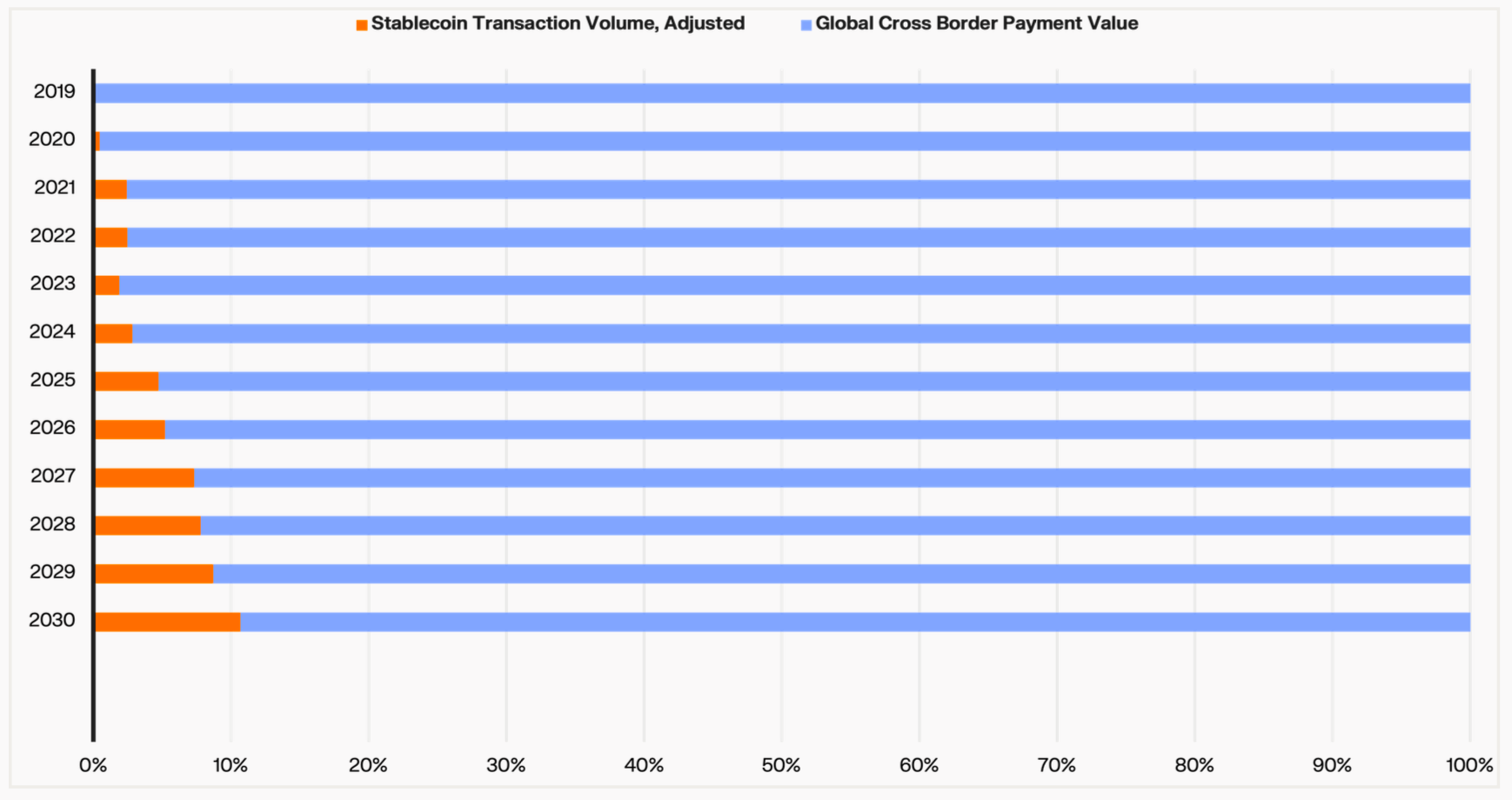
Stablecoin transaction volume vs. cross-border payment volume (Visa, McKinsey, Keyrock)
Given the opportunities, the authors forecasted that every major fintech firms will eventually integrate stablecoin infrastructure over the few next years, just as software-as-a-service (SaaS) tools became ubiquitous.
In practice, that could mean wallets and payment platforms moving value on-chain, treasury desks holding stablecoins and deploying for a yield and merchants settling instantly in multiple currencies.
The rapid growth of stablecoins, which have a market cap of $260 billion, could also have ripple effects on monetary policy. Stablecoin supply could reach 10% of the U.S. M2 money supply in a bull case, up from 1% today, and represent roughly a quarter of the U.S. Treasury bill market and influence how the Federal Reserve manages short-term interest rates.
Read more: JPMorgan Sees Stablecoin Market Hitting $500B by 2028, Far Below Bullish Forecasts

 coindesk.com




