
 u.today
$XRP has recently experienced a sharp rise in network activity. In a single day, over 4,600 $XRP were destroyed, which is twice as much as the average amounts observed earlier this month. Even though this increase in burned tokens may seem remarkable, the market impact as a whole is only moderate.
The price of $XRP is presently hovering just below a descending resistance trendline at about $2.08. The 200 EMA has served as a crucial defense level in recent weeks, and the token has found strong support close to it. The asset is still consolidating and has not committed to a new trend direction, as evidenced by the price action's continued restriction between the $1.95 and $2.24 range.
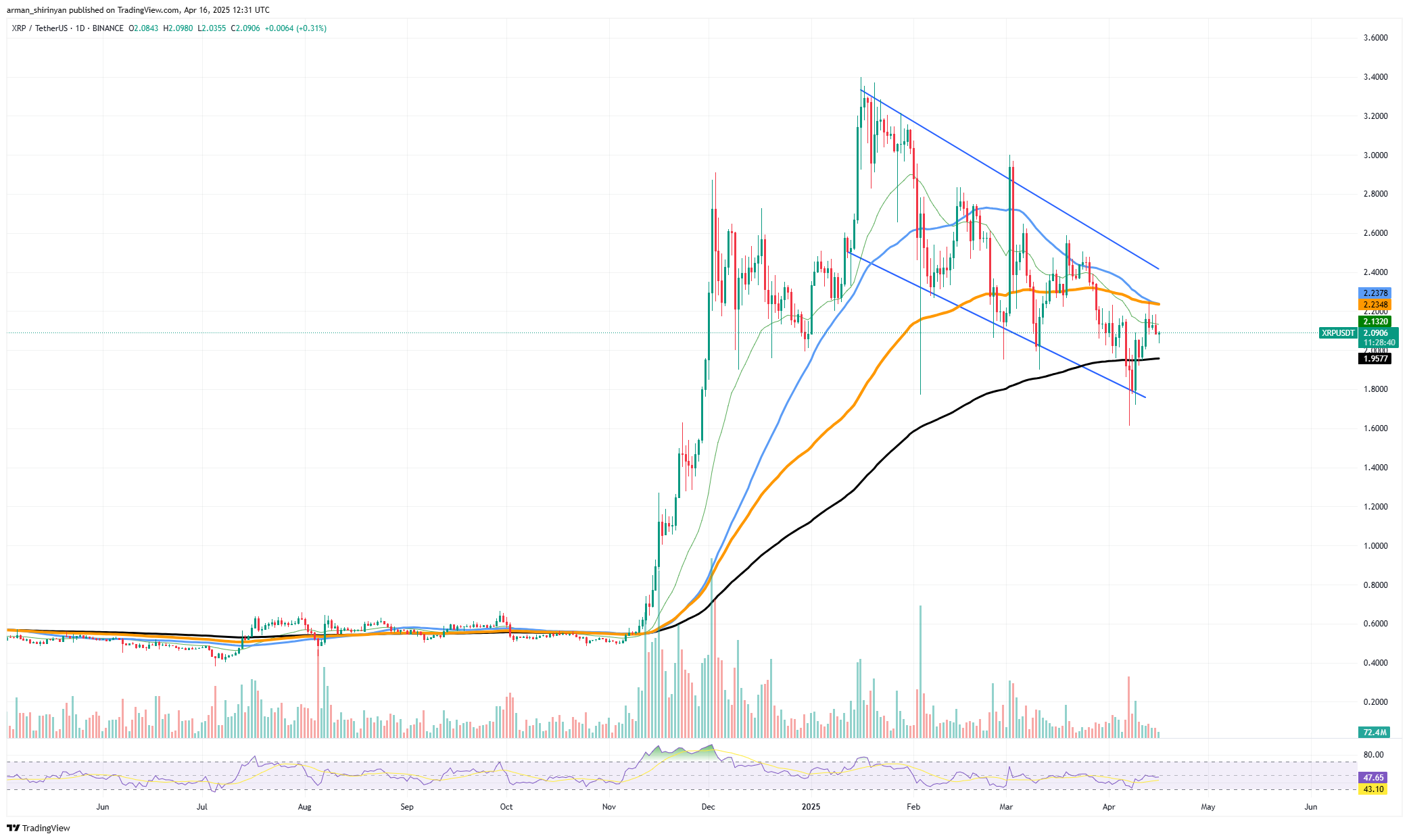
Technically speaking, $XRP remains inside a larger descending channel, which has held back price movement since its local peak around $3.40. Although there was a brief breakout below this pattern in early April, buyers intervened to protect the 200 EMA, which led to a swift recovery. Although a brief increase in network usage is the reason for the 100% increase in burned fees, $XRP's burn mechanism is purposefully simple.
A small portion of $XRP is charged for each transaction — not to drastically cut supply but to keep the network efficient and stop spam. Thus, even burning thousands of $XRP has no discernible impact on market dynamics. $XRP is still in a crucial technical position for the future. A move toward $2.40 and a possible retest of $2.60 could be triggered by a successful breakout above the 100 EMA at $2.24.
If, on the other hand, momentum is not generated at the present levels, there may be a further drop toward $1.95 or even lower, particularly if the mood of the market as a whole deteriorates. To put it briefly, the burn surge is not a game-changer for $XRP, even though it is a symbolic indication of activity. In contrast to short-term fee metrics, traders should concentrate more on price structure, volume and macro signals.