Amid this backdrop, Finbold analyzed the Relative Strength Index (RSI) heatmap from CoinGlass on February 25. With an average 12-hour RSI of 37.50, Finbold identified potential buy opportunities even as volatility continues to challenge market stability.
Bitcoin ($BTC)
Bitcoin ($BTC) is flashing a potential buying opportunity as extreme oversold conditions suggest a short-term rebound. The four-hour RSI has dropped to 17.35, while the 12-hour RSI sits at 20.63, both indicating significant selling pressure that appears to be waning.
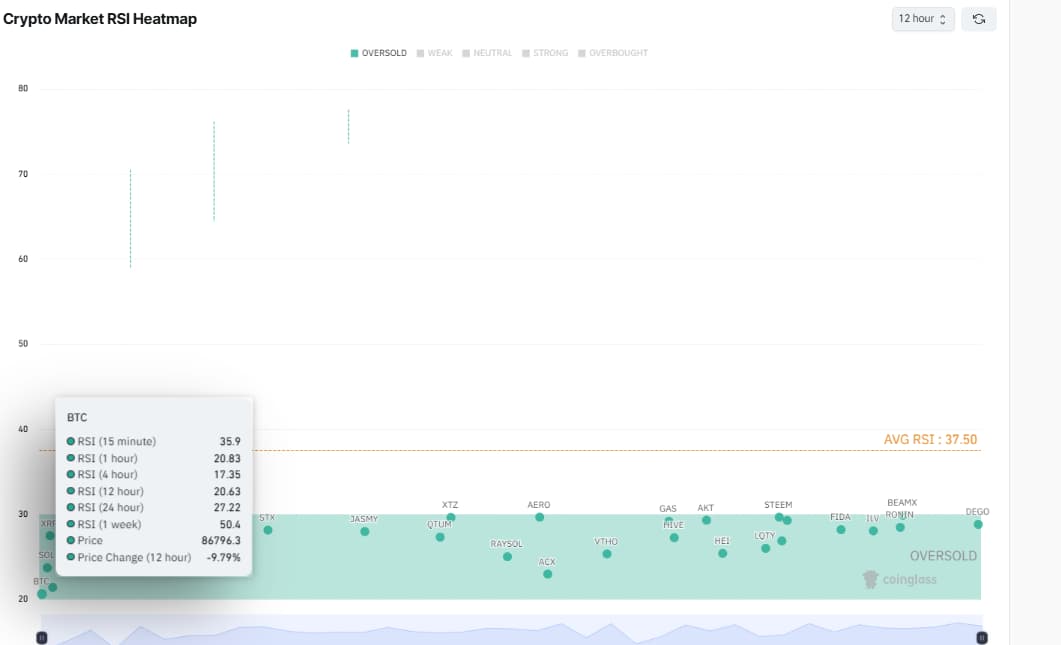
Meanwhile, the 24-hour RSI of 27.22 confirms prolonged weakness, a signal that has historically preceded corrective bounces. $BTC has plunged 9.79% in the last 12 hours, marking a potential local bottom where accumulation often begins.
The technical analysis further supports this outlook, with analysts suggesting that $BTC is experiencing a typical bull cycle pullback, a phase where sharp dips create opportunities before the next leg higher. Historical trends indicate that $BTC could soon stage a strong recovery, making this a compelling entry point for buyers.
$XRP
$XRP is showing similar signs of a potential bottom, with its 12-hour RSI at 27.48 and 4-hour RSI at 25.25, both well below the oversold threshold of 30.
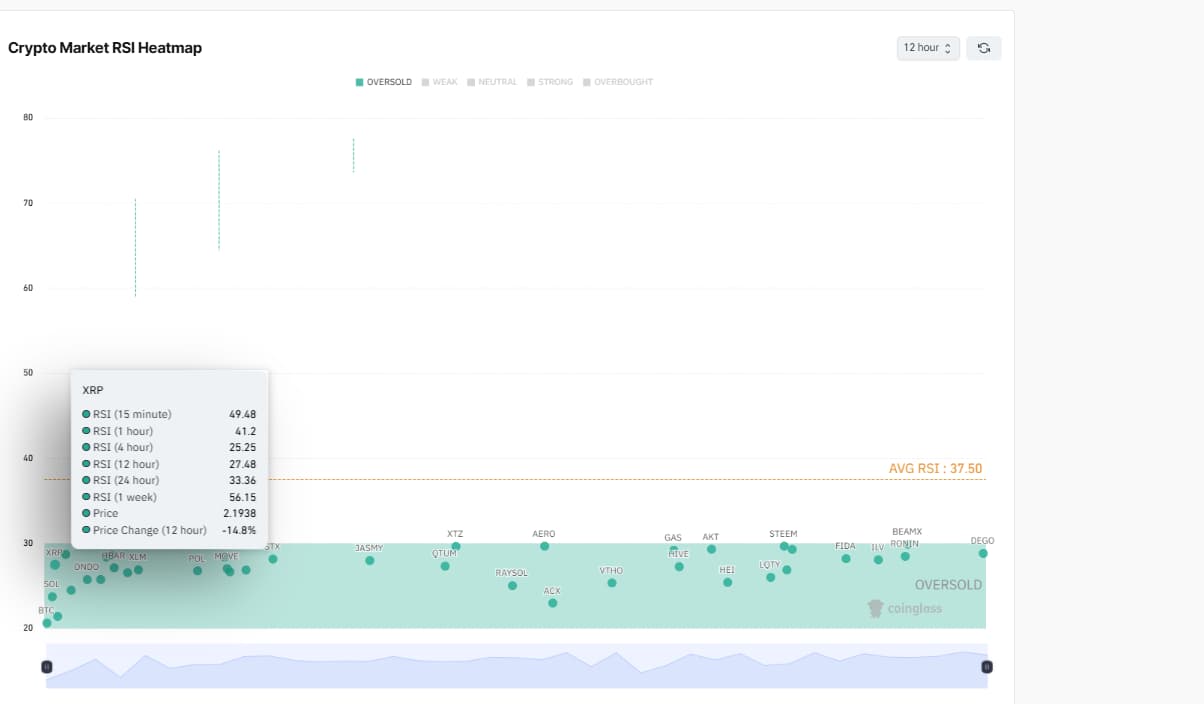
$XRP has plunged 14.8% in the last 12 hours, creating a setup where buyers may soon regain control. Its 24-hour RSI at 33.36, though slightly above the oversold threshold, shows undervaluation aligning closely with broader market conditions.
Supporting these RSI-based signals, weekly technical indicators also lean bullish, with moving averages flashing a strong buy signal despite some mixed signals.
The Exponential and Simple Moving Averages across multiple timeframes remain in buy territory, further strengthening the long-term bullish outlook. While short-term momentum indicators like MACD remain bearish, the broader trend favors accumulation before a potential recovery.
While RSI points to a potential rebound for $BTC and $XRP, relying on a single indicator comes with risks. Market conditions remain volatile, and broader factors like volume, and fundamental developments play a crucial role in shaping price action.
Featured image via Shutterstock

 finbold.com